

Key takeaways
- Choosing 60Hz because the specification lists 4K resolution prominently.
- Assuming every HDMI socket supports 4K at 120Hz.
- Buying by peak brightness alone while ignoring blooming, tone mapping, and game-mode accuracy.
- Choosing an oversized TV for a short viewing distance.
- Using a receiver, cable, or switch that cannot pass 4K at 120Hz and VRR.
- Leaving an OLED paused on a static HUD or menu for an entire day.
The best gaming TVs combine a 120Hz-or-faster panel, low input lag, HDMI 2.1, variable refresh rate (VRR), and strong HDR; for most players, a 55-inch or 65-inch OLED is the best balance of motion quality, contrast, and viewing distance.
Our top picks


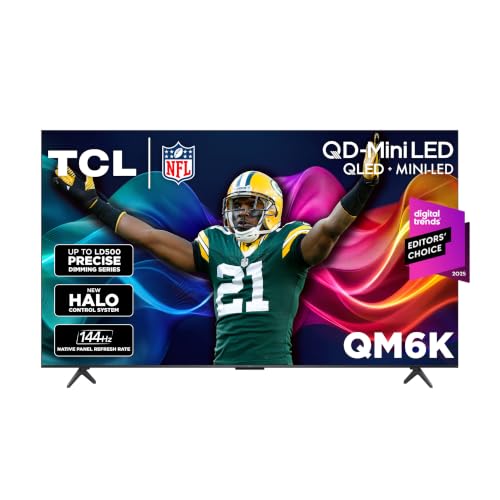
As an Amazon Associate we earn from qualifying purchases at no extra cost to you. Ratings are shown as listed on Amazon.
Quick picks by gaming situation
| Situation | Best fit | Target specifications | Why it makes sense |
|---|---|---|---|
| Bedroom or small desk setup | 42-48 inch OLED | 4K, 120Hz, under 10ms input lag, HDMI 2.1 | Sharp at short distances without dominating the room |
| Typical living room | 55-65 inch OLED or mini-LED LED | 4K, 120-144Hz, VRR, Dolby Vision or HDR10+ | Strong immersion while preserving manageable viewing distance |
| Bright room or daytime sports and gaming | Mini-LED LED TV | High sustained brightness, local dimming, 144Hz, anti-glare coating | Less affected by sunlight and static image concerns |
| Competitive console gaming | 42-55 inch OLED | 120Hz, HDMI 2.1, VRR, ALLM, input lag around 5-10ms | Fast pixel response and clear motion help with aiming and timing |
| Value-focused large screen | 55-75 inch LED or mini-LED | 4K, at least 120Hz, two or more HDMI 2.1 ports | More screen for the money, with good HDR potential |
Choose the screen size by viewing distance
Screen size should follow the distance from your eyes to the panel, not simply the size of the room. A 4K image can look detailed at close range, but sitting too near a very large screen may make menus, camera movement, and competitive play feel tiring. Sitting too far away wastes much of the resolution and HDR impact.
| Viewing distance | Comfortable size range | Immersive upper choice |
|---|---|---|
| 3.5-4.5 feet | 42-48 inches | 48 inches |
| 4.5-6 feet | 48-55 inches | 55 inches |
| 6-8 feet | 55-65 inches | 65 inches |
| 8-10 feet | 65-75 inches | 75 inches |
| 10-12 feet | 75-85 inches | 85 inches |
For example, if your sofa is 7 feet from the TV, a 65-inch model is usually the safer choice than a 75-inch model for mixed use. If gaming is the main purpose and you want a cinema-like field of view, 75 inches can work, but allow yourself time to adapt and avoid placing the screen above eye level.
OLED versus LED: which is better for gaming?
OLED
OLED TVs such as the LG C5 and Samsung S95F use individually controlled pixels. Their key advantage is near-black-level contrast: dark areas in games look clean rather than gray, and bright objects stand out without a broad halo. OLED pixels also change state extremely quickly, so fast camera pans generally look clearer than they do on slower LED panels.
OLED is especially attractive for single-player games, horror titles, racing games, and dim or controlled rooms. Common compromises include a higher purchase price, lower full-screen brightness than some premium mini-LED TVs, and the long-term possibility of image retention from repeated static elements. Modern OLED televisions include pixel-shifting and panel-maintenance features, but these reduce rather than eliminate the need for sensible use.
LED and mini-LED
LED TVs use a backlight behind an LCD layer. Standard LED models are often the least expensive option, while mini-LED models use many smaller backlight zones for better brightness and contrast. A strong mini-LED TV can be the better choice for a sunlit living room, large sports viewing, or games with bright full-screen scenes.
LED’s weaknesses vary by model. Dark scenes may show blooming around subtitles or bright objects, and pixel response can be less consistent. A cheap 120Hz LED TV may still produce less convincing motion than a well-tuned OLED. Look for local dimming, not just a high brightness claim, and check whether the gaming mode preserves acceptable HDR quality.
Features that matter more than the marketing label
Refresh rate and VRR
A 120Hz panel is the practical target for PlayStation 5, Xbox Series X|S, and modern gaming PCs. It can display 120 frames per second where a game supports it and provides a cleaner foundation for 40fps quality modes. PC gamers may benefit from 144Hz or higher, but only if the TV accepts the required signal over HDMI.
VRR synchronizes the display with the console or graphics card when frame rates fluctuate. Look for HDMI Forum VRR, AMD FreeSync, or Nvidia G-Sync compatibility as appropriate. A useful operating range is roughly 40-120Hz; a narrow VRR range can leave the feature ineffective in demanding games.
Input lag
Input lag is the delay between pressing a control and seeing the result. For a responsive feel, target approximately 10ms or less at 4K and 120Hz, and around 15ms or less at 4K and 60Hz. These figures are normally achieved only with the TV’s Game Mode enabled. Image-processing modes designed for movies can add substantial delay.
HDMI 2.1 ports
Full-bandwidth HDMI 2.1 is important for 4K at 120Hz, VRR, and automatic low-latency mode. Check the number of ports, not merely the phrase “HDMI 2.1.” Two ports are workable for one console and a soundbar or receiver; four are much more convenient for multiple consoles and a gaming PC.
Also check whether the eARC port is one of those HDMI 2.1 connections. If you use a soundbar, this affects how you connect the system without sacrificing a high-bandwidth gaming input.
HDR
HDR performance depends on contrast, peak brightness, tone mapping, and game-mode accuracy. OLED provides excellent dark-scene contrast, while mini-LED often delivers higher highlights in bright scenes. HDR10 is required by many sources; Dolby Vision and HDR10+ can matter for supported games and streaming content, but they should not outweigh poor input lag or inadequate HDMI connectivity.
Head-to-head: OLED or mini-LED for common rooms?
| Priority | OLED advantage | Mini-LED LED advantage | Recommended direction |
|---|---|---|---|
| Dark-room contrast | Pixel-level black control | Strong, but possible blooming | OLED |
| Bright daytime viewing | Clear image, but reflections can matter | Higher sustained brightness on many models | Mini-LED LED |
| Fast response | Usually exceptionally quick pixel transitions | Depends heavily on panel tuning | OLED |
| Large-screen value | Usually costs more at 75 inches and above | More size choices at moderate prices | Mini-LED LED |
| Static HUD-heavy games | Requires sensible usage habits | No OLED-specific retention concern | Mini-LED LED for frequent long sessions |
Models and categories worth comparing
The LG C5 is a strong all-round OLED reference for console and PC gaming, with a gaming-focused feature set and multiple high-bandwidth connections. Samsung’s S95F represents a brighter, premium QD-OLED direction, particularly appealing when you want OLED contrast with stronger highlight performance. For LED alternatives, look at current mini-LED ranges such as TCL’s QM7K and higher-tier models from Hisense or Sony, comparing their actual HDMI 2.1 count, local-dimming behavior, and game-mode lag rather than relying on the brand name.
Market pricing changes frequently, but broad ranges are useful: 42-55-inch OLED gaming TVs commonly occupy the midrange to premium category, 65-inch OLED models are typically premium, and 55-75-inch mini-LED TVs often provide more size per dollar. A budget 4K 120Hz LED may be preferable to a small 60Hz OLED if the room is large, but do not buy a large screen that lacks VRR or has only one high-bandwidth input.
Set up a gaming TV correctly
-
Connect the console or PC directly to a full-bandwidth HDMI 2.1 port. Avoid routing the signal through an older receiver or switch.
-
Enable Game Mode, VRR, and ALLM in the TV menus. On the console, enable 120Hz output and HDR calibration where available.
-
Set the TV’s aspect ratio to its native or Just Scan mode. Overscan can crop interface elements and soften the image.
-
Disable unnecessary motion smoothing, noise reduction, and dynamic contrast. These can increase lag or create artifacts.
-
Place the screen with its center close to eye level. Reduce direct window reflections before increasing brightness, since glare can hide shadow detail.
-
For OLED ownership, vary content, avoid leaving paused screens on for hours, and let automatic panel-care routines complete when the TV requests them.
Common buying mistakes
- Choosing 60Hz because the specification lists 4K resolution prominently.
- Assuming every HDMI socket supports 4K at 120Hz.
- Buying by peak brightness alone while ignoring blooming, tone mapping, and game-mode accuracy.
- Choosing an oversized TV for a short viewing distance.
- Using a receiver, cable, or switch that cannot pass 4K at 120Hz and VRR.
- Leaving an OLED paused on a static HUD or menu for an entire day.
Bottom line
For most gamers sitting 6-8 feet away, a 55- or 65-inch OLED with 4K resolution, 120Hz, VRR, low input lag, and at least two HDMI 2.1 ports is the strongest overall choice. Choose mini-LED LED instead when the room is very bright, you want the largest screen for a fixed budget, or your play involves long sessions dominated by static interfaces. The right size and complete gaming connectivity matter more than a television’s headline HDR brightness or refresh-rate number.

Write Your Review
No reviews yet. Be the first to share your experience!