

Key takeaways
- Compare five breathing trainers for stronger lungs: dual-direction dial trainers, an exhale-only clinical device and a kit that measures exhale pressure.
As an Amazon Associate we earn from qualifying purchases.
Breathing trainers all promise stronger lungs, but they train very different things, and picking the wrong type wastes weeks of daily effort. Some devices load only the inhale, some load only the exhale, and the most flexible ones let you set each direction separately. The real decision is matching the trainer to your goal: rebuilding comfortable breathing at home, adding endurance work for sport, or strengthening the exhale behind your cough and voice. Resistance range, dial steps and cleaning demands matter after that match is made.

This guide is for adults recovering at home who want steadier breathing, endurance athletes who want stronger breathing muscles, and singers or wind players building breath control. Every pick below was chosen from the product names and specifications published on its Amazon product page, then cross-checked for identity before inclusion.
Quick Picks
Disclosure: This article contains affiliate links. If you buy through these links, we may earn a commission at no extra cost to you.
Our Short List of 3
- Best for: Home recovery users who want one device that trains both directions with room to progress.
- Brand: The Breather, by PN Medical
- Resistance: 6 inspiratory settings and 5 expiratory settings, independent dials
- Pressure range: -140 to +80 cmH2O for healthy adults; -100 to +43 cmH2O for respiratory impaired users
- Dimensions: 129 x 43 x 46 mm
- Best for: Travelers and commuters who want a small dual-direction trainer for short daily sessions.
- Brand: Tilcare
- Resistance: 6-step dial control covering inhale and exhale resistance
- Package dimensions: 5.32 x 2.05 x 2.05 inches
- Weight: 1.76 ounces

- Best for: Minimalists who want a simple, easy-clean trainer with no accessories to keep track of.
- Brand: Inhale
- Resistance: Adjustable, bi-directional for inhale and exhale
- Mouthpiece: Medical-grade silicone
- Construction: One-piece design, designed and assembled in the USA
All 3 Picks at a Glance
| Product | Specs | Action |
|---|---|---|
| The Breather (PN Medical) |
| Check price on Amazon |
| Tilcare Breathing Trainer |
| Check price on Amazon |
| Inhale Respiratory Trainer |
| Check price on Amazon |
How to Choose
Match the trainer to the breath direction you need
Inspiratory trainers load the muscles that pull air in, mainly the diaphragm, while expiratory trainers load the muscles that push air out, which also drive coughing and speech. If your goal is general recovery and easier everyday breathing, a dual-direction device covers both sides of the breath cycle in one tool. If a clinician has pointed you at cough or swallow support, an exhale-only device concentrates all its resistance where you need it. Buying a single-direction trainer for a two-direction goal is the most common mismatch, so settle this question before comparing dials, sizes or kit contents.
Look for resistance you can progress in small steps
Breathing muscles respond to gradual overload, the same way other muscles do, so the number of resistance steps matters more than the highest setting on the box. A trainer with five or six levels per direction lets you start gently and move up as sessions feel easier, instead of jumping between too easy and impossible. Independent dials for inhale and exhale are worth having because most people are stronger in one direction than the other. Fixed-resistance devices and single-knob designs still work, but they give you fewer rungs on the ladder and can stall progress sooner.
Decide whether you want measured feedback
Most breathing trainers are simple mechanical devices: you judge progress by the dial setting you can handle and how breathless daily tasks feel. A small number of kits add a pressure gauge, such as a needle manometer, so you can record your maximum expiratory pressure every few weeks and see a number move. That feedback suits people who stay consistent when progress is visible, and people following a structured home recovery plan. If you know you will not sit down and test on schedule, skip the gauge and choose the trainer you will simply use every day.
Check cleaning, fit and single-user basics
A breathing trainer lives in your mouth, so hygiene decides whether it stays in your routine. Look for a mouthpiece that detaches or a body that rinses clean and air-dries fully, and check whether the mouthpiece shape suits your mouth before ordering. These devices are single-user items and should never be shared, even within a family. Size matters for consistency too: a compact trainer that fits a pocket or a small case is easier to keep near your chair or gym bag, which is where daily sessions actually happen.
The 5 Best Options
The Breather (PN Medical)
- Best for: Home recovery users who want one device that trains both directions with room to progress.
- Brand: The Breather, by PN Medical
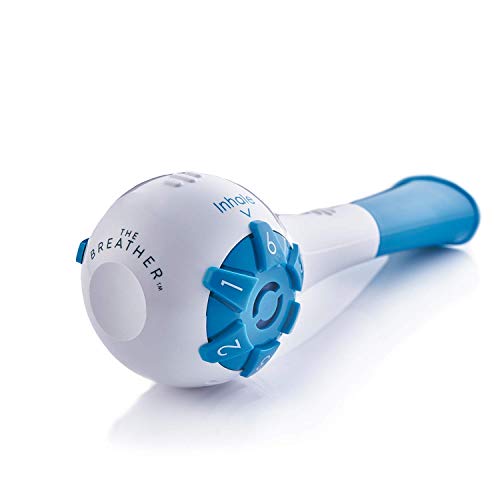
- Resistance: 6 inspiratory settings and 5 expiratory settings, independent dials
- Pressure range: -140 to +80 cmH2O for healthy adults; -100 to +43 cmH2O for respiratory impaired users
- Dimensions: 129 x 43 x 46 mm
Home recovery users who want one device that trains both directions with room to progress.
Confirm you are ordering the original blue model, since a pink variant and a separate Fit model are sold under similar names.
The Breather is the most complete dual-direction option here, with separate dials for the inhale and exhale sides so each can progress at its own pace. Six inspiratory settings and five expiratory settings give it the widest adjustment ladder in this group, and the published pressure ranges cover both healthy adults and people training with reduced respiratory capacity. It is a small, light, air-powered device with no batteries to manage, and a guided mobile training app is included to structure daily sessions for beginners who want a routine to follow.
Tilcare Breathing Trainer
- Best for: Travelers and commuters who want a small dual-direction trainer for short daily sessions.
- Brand: Tilcare
- Resistance: 6-step dial control covering inhale and exhale resistance
- Package dimensions: 5.32 x 2.05 x 2.05 inches
- Weight: 1.76 ounces
Travelers and commuters who want a small dual-direction trainer for short daily sessions.
Check the dial markings against the included instructions when it arrives, since both directions are set from the same control.
Tilcare’s trainer keeps the dual-direction idea but shrinks it into a pocket-sized body with a single 6-step dial system controlling resistance for both inhaling and exhaling. The listing describes medical and food-grade materials, and the whole unit is light enough to disappear into a jacket pocket or a small bag, which suits people who train in short sessions away from home. Because the adjustment is shared across both directions rather than split into two independent dials, progression is simpler but less tailored than on The Breather, a trade-off many casual users will happily accept.
Inhale Respiratory Trainer
- Best for: Minimalists who want a simple, easy-clean trainer with no accessories to keep track of.
- Brand: Inhale
- Resistance: Adjustable, bi-directional for inhale and exhale
- Mouthpiece: Medical-grade silicone
- Construction: One-piece design, designed and assembled in the USA
Minimalists who want a simple, easy-clean trainer with no accessories to keep track of.
Verify the case is in the box on delivery, since it is the only storage protection the listing promises.
The Inhale trainer takes the opposite approach to complexity: a compact one-piece body with adjustable resistance in both directions and a medical-grade silicone mouthpiece. The maker highlights a patent-pending one-piece construction designed and assembled in the United States, which means fewer seams and parts to trap moisture during cleaning. A carrying case is included for storage between sessions. With no gauge, no app and no multi-part kit, this is the pick for people who want to pick the device up, breathe against a steady load, rinse it and put it away.
EMST150 Expiratory Muscle Strength Trainer
The EMST150 is the specialist in this group: it trains the exhale only, using a calibrated dial so the resistance you set today is the same resistance you return to next week. It comes from Aspire, a maker focused on expiratory muscle training, and the device is widely used for programs aimed at the muscles behind breathing out, coughing, swallowing and speaking. There are no inhale settings to manage, which keeps sessions focused, but it also means this device complements rather than replaces a full breathing routine for general fitness goals.
Specs
- Brand: Aspire
- Model: 61779
- Training direction: Expiratory only
- Resistance: Calibrated, adjustable dial
- Form: Handheld, single-user device
Best for: People directed toward exhale, cough or speech muscle training who need repeatable, calibrated resistance.
Watch out for: Confirm expiratory-only training matches your goal before ordering, because this device does not load the inhale at all.
ASIN: B0094ME5BA
Sonmol Lung Trainer with Travel Case
Sonmol’s kit pairs a dual-direction trainer with something the other picks lack: a needle manometer for measuring maximum expiratory pressure. Five resistance levels serve both inhaling and exhaling, and the gauge reads across a 30 to 210 cmH2O range, so you can test every few weeks and record whether your exhale is actually getting stronger. The box also includes a connection tube, a nose clip to keep breathing through the mouth during sessions, and a travel case that keeps the whole kit together at home or on the road.
Specs
- Brand: Sonmol
- Resistance: 5 levels for inhaling and 5 levels for exhaling
- MEP measurement range: 30 to 210 cmH2O
- Dimensions: 3 x 2 x 6 inches
- Weight: 6.35 ounces
- Kit contents: Trainer, needle manometer, connection tube, nose clip, travel case
Best for: Structured home recovery users who want a pressure reading to track exhale progress over time.
Watch out for: The manometer connection must seal airtight for a trustworthy reading, so check the tube fit before your first measurement.
ASIN: B0CLDLPHY9
Which One Fits Your Situation
You are rebuilding breath strength at home
Start with The Breather. Its separate inhale and exhale dials let you begin gently in both directions, and the lower pressure range published for respiratory impaired users suits early recovery sessions. The included training app gives your days a structure, which helps when motivation is thin. Keep sessions short, sit down while training, and stop if you feel dizzy.
You train for endurance sports
The Tilcare and Inhale trainers both fit a gym bag and ask nothing of you beyond a few minutes of loaded breathing. Tilcare’s six steps give finer progression for athletes periodizing their training, while Inhale’s one-piece body shrugs off being tossed in a kit bag. Pick based on whether dial steps or simplicity matters more to your routine.
Your cough and voice need exhale strength
Choose the EMST150. Its calibrated dial exists for exactly this job: repeatable expiratory resistance that targets the muscles behind coughing, swallowing and speaking. Because it ignores the inhale entirely, it pairs well with ordinary breathing exercises rather than replacing them. If a speech or respiratory therapist set your program, its numbered settings make their instructions easy to follow precisely.
You stay consistent when you can see numbers
The Sonmol kit is built for you. The dial settings give you a daily routine, and the needle manometer gives you a monthly test: a maximum expiratory pressure reading you can write down and compare. That record turns a vague feeling of improvement into evidence, which is often what keeps a home program alive past the first month.
Common Mistakes
- Starting at a high resistance setting and quitting within a week because sessions feel punishing instead of productive.
- Training only the inhale when your actual goal, such as cough strength, depends on the exhale muscles.
- Sharing a mouthpiece with a partner or family member, even after rinsing it.
- Skipping cleaning and letting moisture sit inside the device between sessions.
- Expecting a trainer to replace prescribed therapy, medication or a clinician-led recovery plan.
Frequently Asked Questions
How often should I use a breathing trainer?
Most makers of the devices above suggest short daily sessions, commonly once or twice a day for five to ten minutes, starting at the lowest resistance. The Sonmol manual, for example, specifies two daily sessions of five to ten minutes. Consistency over several weeks matters far more than long sessions, so pick a schedule you can keep and increase resistance only when the current setting feels comfortable.
What is the difference between inspiratory and expiratory training?
Inspiratory training loads the muscles that draw air in, chiefly the diaphragm, while expiratory training loads the muscles that push air out, which also power coughing and speech. Dual-direction devices like The Breather and the Tilcare train both sides with separate or shared controls. Exhale-only devices such as the EMST150 concentrate entirely on the out-breath for people whose goals center on cough and voice strength.
Can a breathing trainer replace medical treatment?
No. These are training aids for the breathing muscles, not treatments for lung disease, and they sit alongside prescribed medication and clinician-led rehabilitation rather than replacing either. If you have a diagnosed respiratory condition, recent chest or abdominal surgery, or you use supplemental oxygen, clear any new breathing program with your clinician first and follow their guidance on resistance and session length.
How do I clean a breathing trainer?
Follow the manual for your model, but the usual pattern is to rinse the mouthpiece and body parts in warm water with mild soap after use, rinse again, and let everything air-dry completely before reassembling. Never share the device, and store it dry in its case once clean. Parts that stay damp grow stale quickly, so drying matters as much as washing.
More from Amazon
Programs that pair well with the guide above. Offers and eligibility are set by Amazon and may change.
Collect the home and kitchen items you want in one registry that guests can shop from.
Create a wedding registrySet up recurring deliveries of everyday items on eligible products. Terms and savings are set by Amazon.
Explore Subscribe & SaveFree shipping on eligible items, Prime Video and more. Eligible new members can start with a free trial.
Start a Prime free trialAudiobooks and podcasts to listen to on the go. Eligible new members can start with a free trial.
Try Audible freeAs an Amazon Associate we earn from qualifying purchases.
Write Your Review
No reviews yet. Be the first to share your experience!