

Key takeaways
- Stair width: Measure the narrowest point, including trim, handrails, and wall irregularities.
- Top landing: Confirm that the user can turn and stand safely after leaving the seat.
- Bottom landing: Check for door swings, furniture, and a clear transfer area.
- Rail overhang: Ask how far the rail extends beyond the first and last step. A longer overrun can improve access but may consume hallway space.
- Hinged sections: Measure the area needed to fold a manual or powered hinge without striking a door.
- Track position: A rail mounted close to the wall may preserve handrail space, while an offset rail may provide a better parking position.
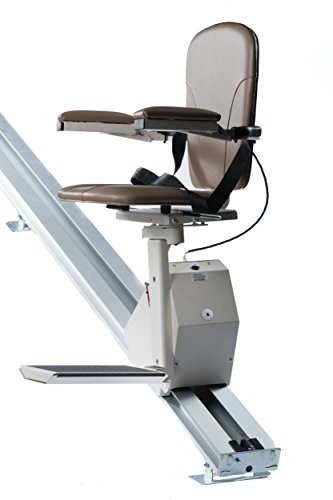
The best stair lifts for safer home access are usually a straight stair lift for a simple staircase, a curved stair lift for landings or multiple flights, and a heavy-duty model when the rider or wheelchair-transfer equipment approaches the standard weight limit.
Choosing the right lift is less about finding the most feature-packed model and more about matching the rail, seat, capacity, charging arrangement, and installation method to the staircase and the person using it. The following guide applies to the main stair-lift types available in 2026, including products from established manufacturers such as Stannah, Bruno, Acorn, and Handicare.
Our top picks


As an Amazon Associate we earn from qualifying purchases at no extra cost to you. Ratings are shown as listed on Amazon.
Best stair lifts by situation
| Home situation | Best choice | Why | Typical installed price range |
|---|---|---|---|
| One straight flight, occasional daily use | Basic straight lift | Simple rail, faster installation, and fewer moving parts | $3,000–$6,000 |
| Straight flight with a narrow hallway | Compact folding-seat model | Reduces the parked footprint at the top or bottom | $3,500–$7,000 |
| Stairs with a 90-degree or 180-degree turn | Curved custom-built lift | Rail follows the bend instead of stopping at each flight | $10,000–$20,000+ |
| User weighs near 300 lb or needs wider seating | Heavy-duty straight or curved model | Higher capacity, stronger seat frame, and often a wider seat | $5,000–$22,000+ |
| Temporary need or uncertain long-term requirement | Refurbished or rental straight lift | Can reduce upfront cost, but availability and fit are limited | $1,500–$4,500 purchase; rental varies |
Prices are broad North American market ranges for equipment and professional installation. A curved lift is expensive because the rail is measured, designed, manufactured, and fitted for one staircase rather than selected from a standard length.
Straight versus curved stair lifts
Straight stair lifts
A straight lift runs along one uninterrupted flight with no intermediate landing or turn. The rail is commonly supplied in standard sections and cut or configured to suit the staircase. This makes it the quickest option to install: many installations take a few hours once the correct measurements and electrical requirements are confirmed.
The main advantages are lower cost, easier servicing, and a smaller selection risk. If the staircase has a top or bottom landing, check whether the rail needs a short extension, a manually hinged section, or a powered hinge. A hinged rail may be important where a doorway, corridor, or room entrance would otherwise be blocked.
Curved stair lifts
A curved lift is designed for stairs with a bend, intermediate landing, spiral section, or several flights that cannot be covered by one straight rail. Its custom rail can include changes in angle and gradient. Some designs allow the seat to rotate or travel farther onto the landing at the top, which can make getting off easier in a restricted space.
Curved systems normally cost substantially more and require a detailed survey. Ask the installer whether the quote includes every flight, intermediate charging point, rail extensions, removal of an old lift, and changes requested after the survey. A curved rail can sometimes be installed closer to the steps than a straight rail, but it may also reduce usable width on tight stairs.
Rail measurements that decide whether a lift fits
Do not rely on the number of steps alone. A proper survey should record the stair width, total run, rise, tread depth, landing dimensions, ceiling clearance, and the position of doors and radiators. For a curved staircase, the survey should also capture every change in direction and the amount of space available for the seat to turn or park.
- Stair width: Measure the narrowest point, including trim, handrails, and wall irregularities.
- Top landing: Confirm that the user can turn and stand safely after leaving the seat.
- Bottom landing: Check for door swings, furniture, and a clear transfer area.
- Rail overhang: Ask how far the rail extends beyond the first and last step. A longer overrun can improve access but may consume hallway space.
- Hinged sections: Measure the area needed to fold a manual or powered hinge without striking a door.
- Track position: A rail mounted close to the wall may preserve handrail space, while an offset rail may provide a better parking position.
As a practical screening guide, many standard lifts need roughly 28–32 inches of usable stair width, but this is not a universal minimum. Seat width, armrest spacing, rail geometry, and the manufacturer’s clearance requirements can change the result. Have the installer measure the actual staircase before ordering.
Weight limits, seat comfort, and transfers
Standard stair lifts commonly support about 275–350 lb, while heavy-duty versions may support approximately 350–600 lb depending on the model and rail configuration. The stated limit includes the rider, clothing, bags, and anything carried on the seat. Never treat a published maximum as a target; allow a margin for comfortable, stable use.
Seat comfort depends on more than cushion thickness. Compare:
- Seat width and depth: A wider seat may be more comfortable but can reduce stair clearance.
- Seat height: The user’s feet should rest securely without the knees being forced into an uncomfortable position.
- Swivel action: A manual or powered swivel can turn the seat toward the landing for the transfer.
- Armrests: Flip-up armrests help with transfers and can make a narrow staircase easier to use.
- Footrest: Look for a stable, non-slip surface and enough room for both feet.
- Seat belt: A retractable belt is useful only if it can be fastened and released easily by the intended user.
Try the chair, if possible, with ordinary footwear and any clothing normally worn at home. A person with balance, joint, strength, or transfer concerns should ask an occupational therapist or other qualified professional to assess the setup rather than relying only on a showroom demonstration.
Backup power and daily reliability
Most modern stair lifts use rechargeable batteries and continue to operate during a mains power outage. Typical systems use two 12-volt sealed lead-acid batteries, with a combined capacity around 14–20 amp-hours. A fully charged lift may provide roughly 15–30 one-way trips, although rider weight, rail length, battery age, temperature, and charging habits affect the actual figure.
| Power detail | Typical figure | What it means |
|---|---|---|
| Battery type | Two sealed 12 V batteries | Low-maintenance backup power; normally replaced as a pair |
| Recharge time | About 8–12 hours after substantial discharge | Leave the lift parked on a charging point when not in use |
| Trips after full charge | Approximately 15–30 one-way trips | Actual range varies with load, rail length, and battery condition |
| Battery replacement interval | Often 2–5 years | Frequent use and poor charging conditions can shorten battery life |
Ask where the charging contacts are located and whether the lift charges at the top, bottom, or both ends. A system that only charges at one end may be inconvenient if it is routinely left elsewhere. Confirm whether the controls, alarm, and emergency lowering procedure still work during an outage.
Installation: what a good quote should include
Most stair lifts attach to the stair treads or a supported rail structure rather than requiring major wall construction. Professional installation should include a site survey, rail fitting, electrical connection if needed, safety testing, user instruction, and removal of packaging. Straight installations are often completed in a single visit; curved installations usually take longer and may require a separate manufacturing lead time.
Before signing, request a written breakdown covering:
- New, refurbished, or rental equipment status
- Rail length, hinges, overrun, and swivel-seat options
- Installation, removal, delivery, and any electrical work
- Parts and labor warranty periods
- Response time for breakdowns and availability of local technicians
- Battery, remote-control, and upholstery replacement costs
Do not allow a bargain quote to omit the survey. A lift that technically reaches the top but leaves the rider facing a wall, blocking a door, or unable to transfer safely is not a good value.
Ownership realities: cleaning, wear, and common mistakes
The first parts to wear are usually the batteries, drive rollers or gears, seat swivel mechanism, armrest locks, and remote-control batteries. Keep the rail free of dust and pet hair, wipe the seat and controls with a manufacturer-approved cleaner, and never spray liquid directly into the joystick or charging contacts. Do not use the footrest as a step or carry heavy objects that could alter the balance of the chair.
A useful runtime calculation illustrates why charging matters. If a household makes six one-way trips per day, a battery offering 20 typical trips provides about three days of theoretical travel. A safety margin is essential because capacity declines with age, so leaving the lift continuously on its charging points is preferable to waiting until the battery is nearly empty.
Final buying decision
Choose a straight lift when the staircase is one uninterrupted flight and the lowest total cost matters. Choose a curved lift when a landing or bend makes a straight rail unsuitable, particularly when a custom parking position improves the transfer. Choose heavy-duty seating when capacity, seat width, or armrest clearance demands it, and verify the complete loaded weight rather than the rider’s weight alone.
Get at least two site-survey quotes, compare the same options line by line, and ask the intended user to practice boarding, fastening the belt, operating the controls, and leaving the seat at both ends. If the staircase or transfer area presents a specific mobility or balance concern, obtain advice from a qualified professional before installation.




Write Your Review
No reviews yet. Be the first to share your experience!