

Key takeaways
- Scale length: Around 17 inches leaves more room between frets. This helps fingerstyle accuracy and reduces cramped chord shapes, but stretches may feel larger for players with small hands.
- Nut width: About 1.38 inches feels relatively compact; about 1.5 inches gives the fretting fingers more lateral space. Width matters more than a few millimetres of total body length.
- Body depth: A deeper tenor body can add volume and bass, but may press against the forearm or feel bulky when seated. A thinner body can be easier to hold but may sound less full.
- Upper-bout and lower-bout size: A wide lower bout can improve acoustic fullness while making the instrument occupy more space on a small lap. Try a seated playing position, not only a standing one.
- Neck profile: A rounded profile may feel comfortable for relaxed chord work, whereas a flatter profile can suit players who move quickly between shapes. This specification is often missing from product listings, so a return policy matters.
Best Tenor Ukuleles for Comfort and Clear Tone
The best tenor ukuleles for most players are the Kala KA-T for affordable all-round comfort, the Cordoba 20TM-CE for a clearer and more projecting acoustic tone, and the Martin T1K for players who want premium solid-koa character and long-term build quality.
A tenor ukulele is usually the most comfortable size for adults who want more room between frets without moving to a baritone. Its scale length is commonly about 17 inches, compared with roughly 13.5 inches for a soprano and 15 inches for a concert ukulele. That extra length gives notes more separation and can make fingerstyle playing easier, but the wider body may feel less convenient on a small chair or while standing.
Our top picks
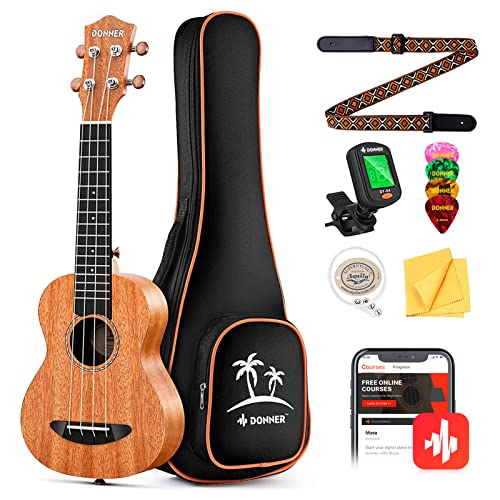


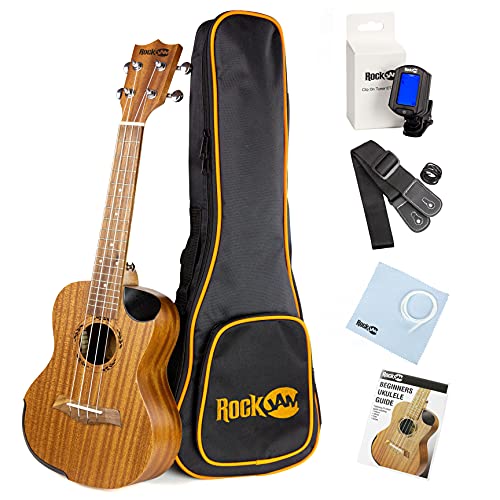
As an Amazon Associate we earn from qualifying purchases at no extra cost to you. Ratings are shown as listed on Amazon.
Quick comparison of the leading choices
| Model | Scale length | Nut width | Construction and tonewood | Approx. weight | Best suited to |
|---|---|---|---|---|---|
| Kala KA-T | 17 inches | About 1.5 inches | Mahogany top, back and sides; laminate construction | About 1.5–1.8 lb | Beginners and regular strummers |
| Cordoba 20TM-CE | 17 inches | About 1.38 inches | Solid spruce top with mahogany back and sides | About 1.5–2 lb | Clear projection and amplified playing |
| Martin T1K Uke | 17 inches | About 1.5 inches | Solid koa top, back and sides | About 1.5–2 lb | Premium tone and refined build quality |
| Kanile’a K-1T | About 17 inches | About 1.5 inches | Solid Hawaiian koa construction | About 1.5–2 lb | Players prioritising traditional Hawaiian tone |
Dimensions and weight can vary slightly by production year, finish and electronics. More important than a small difference in body weight is how the neck feels in your left hand and whether the instrument stays in tune after several minutes of playing.
Best overall for comfort: Kala KA-T
The Kala KA-T is a sensible starting point when comfort, predictable setup and moderate cost matter more than exotic materials. Its approximately 17-inch scale provides the spacious tenor feel, while the roughly 1.5-inch nut gives many adult players enough room for clean chord shapes without making the neck feel unusually broad.
Mahogany laminate tends to produce a balanced, warm sound with a controlled high end. It may not have the complex overtones of a well-made solid-wood instrument, but it is less sensitive to ordinary changes in temperature and humidity. That makes the KA-T practical for lessons, travel between rooms and frequent casual playing.
Choose this model if you are buying your first tenor, mainly strum chords, or want an instrument that is less stressful to maintain. A version with built-in electronics can be useful for an amplifier or recording interface, but it adds cost and battery management. If you rarely play amplified, the non-electric version is the simpler purchase.
Best for clear projection: Cordoba 20TM-CE
The Cordoba 20TM-CE is the stronger choice when “clear tone” means strong note definition, audible fingerpicking and useful amplified output. Its solid spruce top generally emphasises attack and separation, while the mahogany back and sides add warmth. The narrower nut, listed at approximately 1.38 inches, may suit players who prefer compact chord shapes and fast single-note lines.
That narrower neck is not automatically more comfortable. Players with larger hands may find a 1.5-inch nut easier for avoiding accidental contact between adjacent strings. Conversely, someone moving from guitar or a smaller ukulele may appreciate the Cordoba’s more compact left-hand feel.
The cutaway makes upper-fret access easier, and the onboard electronics are convenient for performances or direct recording. The trade-off is that a pickup system introduces another component that can eventually need attention: batteries, output jacks and controls are all potential maintenance points.
Best premium option: Martin T1K Uke
The Martin T1K Uke is aimed at players who already know they want a tenor and are willing to pay for solid koa construction. Koa can deliver a focused midrange, articulate attack and a distinctive visual appearance. As the instrument opens up with use, the tone may become more resonant, although the exact result varies between individual pieces of wood.
Its approximately 17-inch scale and tenor body provide comfortable spacing for fingerstyle, while the familiar wider tenor nut supports clean fretting for many adult players. This is a particularly good fit for a committed player who practises several times a week and wants an instrument that can remain a long-term primary ukulele rather than a temporary beginner model.
Solid wood requires more environmental care than laminate. Avoid leaving it in a hot vehicle, next to a radiator or in a very dry room. A quality case and a small digital humidity monitor are worthwhile additions, especially if the ukulele is stored for long periods.
Best for traditional Hawaiian character: Kanile’a K-1T
The Kanile’a K-1T belongs in the premium category and is best considered by players who specifically value Hawaiian construction, solid koa and a responsive acoustic voice. It is not the most economical choice for learning basic chords, but its craftsmanship and tonal detail can reward a player who uses a tenor as a main instrument.
Before paying a premium, check the practical details that listings often omit: the neck profile, the exact nut width, the included case and whether the instrument has electronics. Two ukuleles made from similar wood can feel very different because of neck shape, fret finishing and setup.
How scale length, neck width and body size affect comfort
- Scale length: Around 17 inches leaves more room between frets. This helps fingerstyle accuracy and reduces cramped chord shapes, but stretches may feel larger for players with small hands.
- Nut width: About 1.38 inches feels relatively compact; about 1.5 inches gives the fretting fingers more lateral space. Width matters more than a few millimetres of total body length.
- Body depth: A deeper tenor body can add volume and bass, but may press against the forearm or feel bulky when seated. A thinner body can be easier to hold but may sound less full.
- Upper-bout and lower-bout size: A wide lower bout can improve acoustic fullness while making the instrument occupy more space on a small lap. Try a seated playing position, not only a standing one.
- Neck profile: A rounded profile may feel comfortable for relaxed chord work, whereas a flatter profile can suit players who move quickly between shapes. This specification is often missing from product listings, so a return policy matters.
Decision matrix: which tenor ukulele fits your situation?
| Your situation | Most suitable direction | Why |
|---|---|---|
| First ukulele, limited budget | Kala KA-T or similar laminate tenor | Stable, durable construction and lower replacement risk |
| Small hands or preference for compact chords | Narrower-neck tenor such as the Cordoba 20TM-CE | Less lateral finger stretch, especially for fast chord changes |
| Fingerstyle and recording | Spruce-top tenor with a well-finished fretboard | Clear attack helps separate individual notes |
| Frequent travel or changing indoor conditions | Laminate or weather-resistant construction | Less vulnerable to ordinary humidity swings than solid wood |
| Playing several times a week for years | Solid-wood Martin or Kanile’a tenor | Higher materials and build quality can justify the investment |
| Amplified performance | Tenor with a reliable onboard pickup | Avoids relying on an external microphone in noisy settings |
Tuning stability: what matters after the brand name
Good tuning stability depends on the tuners, nut slots, bridge, strings and temperature—not only the manufacturer. Geared tuners are usually easier for beginners than friction tuners because they hold tension predictably and allow finer adjustments. However, even quality tuners cannot compensate for strings that are still stretching or a nut slot that grips the string.
New nylon or fluorocarbon strings may require several days of repeated retuning. Tune the instrument, play for a few minutes, then tune it again. Stretch each string gently along its length without excessive force, and check the tuning at both open strings and the fifth or seventh fret. If open notes are in tune but fretted notes sound noticeably sharp, the issue may be intonation or setup rather than the tuners.
Ownership costs and maintenance
A reasonable market range for a dependable laminate tenor is roughly $100–$250, while solid-top and better-equipped models commonly fall around $250–$600. Premium solid-koa instruments can cost $700 or considerably more. Budget separately for a padded case, which often costs about $30–$100, and replacement strings at roughly $8–$20 per set.
For example, a player practising four times a week for two years uses an instrument for about 416 sessions. A $200 ukulele plus $50 for a case and $30 for strings totals $280, or approximately $0.67 per session before any accessories or repairs. That calculation favours buying a comfortable, serviceable instrument over choosing the cheapest model and replacing it after a frustrating setup.
- Wipe fingerprints and sweat from the strings and finish after each session.
- Replace strings when tuning becomes unstable, the surface feels rough or the tone has dulled noticeably.
- Keep the ukulele in its case when not in use, away from direct sunlight and heating vents.
- Do not overtighten tuners or force a bridge pin, if fitted.
- Have a qualified repair technician correct high action, sharp fret ends or persistent buzzing rather than filing parts yourself.
Final recommendation
Choose the Kala KA-T for the safest affordable introduction to the tenor format. Pick the Cordoba 20TM-CE if clear projection, fingerstyle definition and amplification are priorities. Move to the Martin T1K Uke or Kanile’a K-1T when you already play regularly and will protect a solid-wood instrument. Whichever model you choose, compare the nut width and neck profile as carefully as the tonewood: a ukulele that fits your hand will usually produce cleaner, more relaxed playing than one selected by appearance alone.

Write Your Review
No reviews yet. Be the first to share your experience!