

Key takeaways
- Wrist circumference under 165 mm: consider 36–39 mm cases and shorter lug lengths.
- Wrist circumference around 165–185 mm: 39–41 mm cases are usually versatile.
- Wrist circumference over 185 mm: 41–45 mm cases may look proportionate, provided the lugs do not overhang.
The best pilot watches for clear, classic timing are the Hamilton Khaki Aviation Pilot Pioneer for a mechanical everyday option, the Laco Augsburg 39 for traditional flieger styling, the Citizen Promaster Skyhawk A-T for practical quartz functions, and the IWC Pilot’s Watch Mark XX for a refined premium choice.
Pilot watches are easiest to compare by asking how you will use the dial rather than choosing by aviation styling alone. A large, high-contrast face helps with quick glances; quartz is usually the practical choice for accuracy and low maintenance; an automatic movement adds mechanical character; and a comfortable strap matters more than a second crown or decorative cockpit detail if you wear the watch all day.
Our top picks


As an Amazon Associate we earn from qualifying purchases at no extra cost to you. Ratings are shown as listed on Amazon.
Best pilot watches by situation
| Best for | Recommended watch | Why it fits | Main compromise |
|---|---|---|---|
| Classic flieger appearance | Laco Augsburg 39 | 39 mm case, highly legible black dial, automatic movement, traditional pilot layout | Limited water resistance compared with many sports watches |
| Mechanical everyday wear | Hamilton Khaki Aviation Pilot Pioneer | Readable numerals, automatic movement, 100 m water resistance, practical 38 mm case | Less historically stark than a traditional Type A flieger |
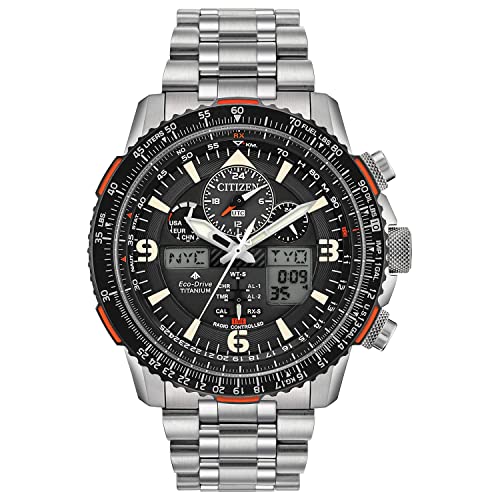
| Maximum timing functions | Citizen Promaster Skyhawk A-T | Atomic timekeeping, solar charging, chronograph, alarms, multiple time zones | Busy dial and substantially larger case |
| Premium classic pilot watch | IWC Pilot’s Watch Mark XX | 40 mm case, excellent dial hierarchy, automatic movement, 100 m water resistance | High purchase price and relatively restrained feature set |
| Rugged technical design | Sinn 856 | 40 mm case, antimagnetic construction, strong legibility, 200 m water resistance | Tool-watch appearance and higher cost than entry-level models |
Head-to-head: readability and case size
Dial readability depends on contrast, spacing, hand shape, and the amount of information competing for attention. A traditional flieger watch uses a matte black dial, bold white markers, oversized hands, and a triangular index at 12 o’clock. This remains one of the clearest arrangements for reading the time at a glance.
The Laco Augsburg 39 is a strong example of this approach. Its 39 mm case suits many wrists without losing the visual presence expected from a pilot watch. Larger versions, such as 42 mm or 45 mm flieger cases, can be easier to read in isolation but may feel top-heavy on a smaller wrist.
The Hamilton Khaki Aviation Pilot Pioneer takes a more instrument-like approach. Numerals and minute markings are prominent, while the 38 mm case keeps the watch wearable under a shirt cuff. It is a sensible middle ground for someone who wants aviation character without a very large watch.
The IWC Pilot’s Watch Mark XX uses a cleaner, more restrained dial. Its 40 mm case is large enough for legibility but not so large that it dominates everyday clothing. The advantage is visual calm: hours, minutes, seconds, and date are easy to separate. The disadvantage is that it offers less information than a digital-analog aviation instrument.
The Citizen Promaster Skyhawk A-T is the opposite choice. Its display provides far more information, but reading the time requires selecting the correct area of the dial. The case is approximately 45 mm wide and over 13 mm thick, so it suits readers who value functions more than discreet proportions.
Movement choice: automatic, quartz, or solar
Automatic movements
An automatic pilot watch is powered by a rotor that winds the mainspring as you wear it. Models such as the Laco Augsburg 39, Hamilton Pilot Pioneer, IWC Mark XX, and Sinn 856 generally offer around 38 to 72 hours of power reserve, depending on the movement and reference. If left unworn, they stop and need resetting.
Choose automatic if you enjoy mechanical construction, a sweeping seconds hand, and a watch that can be serviced for many years. Do not choose it solely for superior accuracy: a well-regulated mechanical watch is still normally less precise than quartz, and accuracy can vary with position, temperature, and magnetic exposure.
Quartz and solar movements
Quartz is the better option when dependable timing and low attention matter most. The Citizen Promaster Skyhawk A-T combines quartz regulation with a light-powered rechargeable cell and radio-controlled time adjustment in supported regions. A solar quartz watch can run for months in darkness after a full charge, but it still needs regular exposure to light.
Battery-powered quartz pilot watches are often thinner and less expensive than mechanical alternatives. Their likely maintenance needs are simple: battery replacement at the recommended interval, pressure testing after case work, and replacement of worn seals.
Water resistance and aviation-inspired features
Water resistance is useful even if a watch never enters an aircraft. It protects against rain, hand washing, and accidental splashes. A rating of 50 m is generally suitable for everyday splashes, while 100 m gives more practical margin for swimming when the manufacturer permits it. A 200 m rating, such as that found on the Sinn 856, is more robust but does not automatically make every crown or strap arrangement suitable for diving.
Traditional pilot features include oversized crowns that can be operated with gloves, luminous hands and markers, a high-contrast dial, a seconds hand that can support basic timing, and a rotating bezel or internal timing scale. Modern aviation watches may add a chronograph, countdown timer, UTC or dual-time display, compass-style bezel, alarm, or electronic navigation functions.
These features have different practical value. A second time zone helps frequent travelers. A chronograph can time a task, but its small subdials may reduce primary-time readability. A slide-rule bezel is historically interesting but has a learning curve and is rarely faster than a phone for complex calculations. Buy the feature you will use, not the one that merely signals aviation.
Strap comfort and wrist fit
Measure your wrist with a flexible tape, then compare that measurement with the watch’s lug-to-lug length rather than case diameter alone. As a starting guide:
- Wrist circumference under 165 mm: consider 36–39 mm cases and shorter lug lengths.
- Wrist circumference around 165–185 mm: 39–41 mm cases are usually versatile.
- Wrist circumference over 185 mm: 41–45 mm cases may look proportionate, provided the lugs do not overhang.
Leather straps are light, quiet, and traditionally styled, but sweat and water shorten their life. Nylon or fabric straps dry more easily and can be inexpensive to replace. Stainless-steel bracelets tolerate moisture well and distribute weight effectively, although they may feel warmer and heavier. For an oversized watch, a soft fabric strap can improve comfort by reducing the rigid, top-heavy feel.
Check lug width before buying replacement straps. Common pilot-watch widths include 20 mm and 22 mm. A strap that is too narrow can make a large case look unbalanced; one that is too wide will not fit safely.
A practical ownership calculation
Suppose a mechanical pilot watch costs about $900 and remains in regular use for eight years before a scheduled service costing roughly $250 to $500, excluding repairs. Using the midpoint service estimate of $375, the purchase and service total is approximately $1,275. At four wears per week for eight years, that is:
4 wears × 52 weeks × 8 years = 1,664 wears.
$1,275 ÷ 1,664 wears = about $0.77 per wear.
This is not a prediction of resale value or total ownership cost, but it shows why strap durability, servicing, and regular use matter more than a small difference in the initial price. A quartz watch may cost less to maintain, while a mechanical model can offer greater emotional and mechanical appeal.
What wears first and how to avoid mistakes
- Straps: leather develops sweat marks and cracks first. Rotate straps and let leather dry naturally away from radiators and direct heat.
- Crown seals: repeated crown operation and aging can reduce water resistance. Have seals checked when the battery is changed or the case is opened.
- Luminous material: modern lume does not need sunlight to remain permanently bright; it must be charged by light and gradually fades in darkness.
- Crystal and bezel: mineral glass is more impact-tolerant in some designs but scratches more readily than sapphire. Sapphire resists scratches but can chip after a hard edge impact.
- Magnetism: speakers, magnetic clasps, tablets, and some bags can affect mechanical watches. If a watch suddenly gains or loses time, magnetic exposure is one possible cause.
- Water resistance: never operate the crown or pushers underwater. A water-resistance number is not a permanent guarantee; gaskets age and impacts can compromise seals.
Which best pilot watch should you buy?
Choose the Laco Augsburg 39 if clean, historically recognizable flieger design is your priority. Choose the Hamilton Khaki Aviation Pilot Pioneer if you want an automatic watch with everyday versatility and 100 m water resistance. Choose the Citizen Promaster Skyhawk A-T if accurate timing, solar power, alarms, and multiple aviation-style functions matter more than a simple dial. Choose the IWC Pilot’s Watch Mark XX for premium finishing and a balanced 40 mm everyday case, or the Sinn 856 for stronger water resistance and a technical, durable personality.
The best pilot watches are not necessarily the largest or most complicated. The right choice is the one whose dial you can read instantly, whose case fits without overhang, whose strap suits your climate, and whose movement matches how often you want to set, charge, or service it.

Write Your Review
No reviews yet. Be the first to share your experience!