

Key takeaways
- Use the largest practical pipe size already supported by the equipment pad.
- Avoid unnecessary sharp elbows immediately before the pump inlet.
- Keep the suction line short and free of air leaks.
- Match the pump’s connection type—threaded, slip, or union—to the existing plumbing plan.
- Check that the filter, heater, chlorinator, and valves can handle the selected flow.
The best pool pumps are usually variable-speed models sized to your pool’s required flow and plumbing—not simply the pump with the highest horsepower. For most residential pools, choose a pump that can deliver the required circulation flow at a lower speed, has ports compatible with your existing plumbing, and includes programmable schedules for daily filtration.
Our top picks


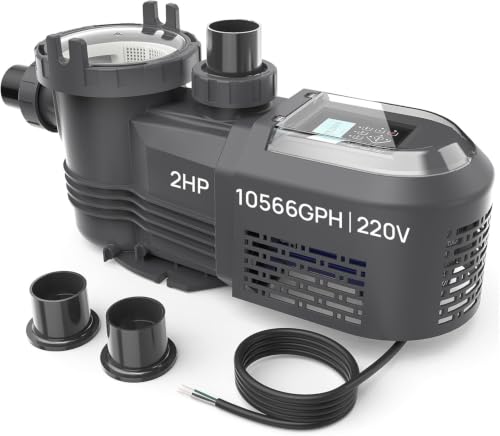
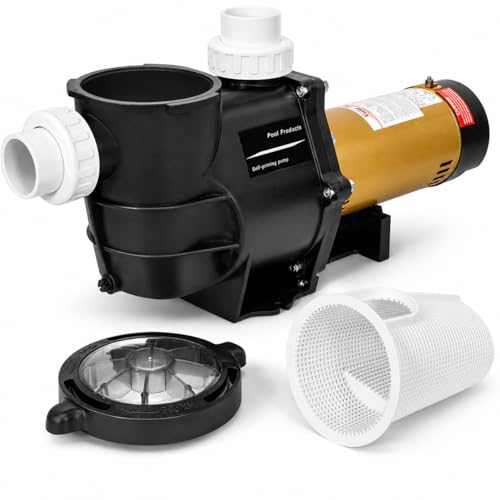
As an Amazon Associate we earn from qualifying purchases at no extra cost to you. Ratings are shown as listed on Amazon.
How to match a pump to your pool
Begin with the pool volume, then estimate the circulation rate needed for one complete turnover. A turnover is the time required to move a volume of water equal to the pool’s capacity through the filtration system.
For example, a 20,000-gallon pool needing an eight-hour turnover requires:
20,000 gallons ÷ 480 minutes = about 42 gallons per minute (GPM)
This is a planning figure, not a guarantee of actual filtration performance. Pipe length, elbows, filters, heaters, salt cells, water features, and elevation changes all add resistance. A pump may be advertised at a high maximum flow, but its useful flow at your system’s total resistance can be much lower.
For many pools, a pump capable of approximately 40 to 70 GPM at the system’s operating head provides practical circulation capacity. Oversizing can increase electricity use, noise, filter pressure, and wear without making the water cleaner.
Best pool pumps by installation situation
| Pool situation | Useful target | Best pump type | Why it fits |
|---|---|---|---|
| Small above-ground pool, up to 10,000 gallons | 25–45 GPM; 0.5–1.0 HP | Compact single-speed or entry variable-speed pump | Lower purchase cost and sufficient flow for short plumbing runs |
| Typical in-ground pool, 10,000–25,000 gallons | 35–65 GPM; roughly 1.0–1.65 HP | Variable-speed pump | Balances filtration, lower operating cost, and flexible scheduling |
| Large pool, 25,000–40,000 gallons | 50–85 GPM; roughly 1.5–3.0 HP | Variable-speed or variable-speed-and-flow pump | Provides reserve capacity for longer plumbing and larger filters |
| Pool with a spa, heater, or water feature | Separate circulation and feature-flow requirements | Variable-speed pump, sometimes with a dedicated booster pump | Allows quiet low-speed filtration without running the feature at full power |
| Replacement in a tight equipment pad | Match port location and union size first | Drop-in replacement or compact variable-speed model | Reduces replumbing and preserves service access |
Variable-speed versus single-speed pumps
Variable-speed pumps
Variable-speed pumps use a permanent-magnet motor and electronic controls to run at several speeds. They are usually the best choice when the pump operates for many hours each day, especially on pools with heaters, salt chlorine generators, solar systems, or automatic cleaners.
The advantage comes from running slowly for filtration and increasing speed only when needed. A low speed may provide adequate everyday circulation while using substantially less power than full-speed operation. The exact savings depend on pipe resistance, runtime, electricity rates, and the programmed speed.
Examples of established variable-speed product families include the Pentair IntelliFlo3, Hayward TriStar VS and MaxFlo VS lines, and Jandy VS FloPro models. Confirm the exact motor rating, controller compatibility, voltage, and plumbing connections before buying because each family is sold in multiple configurations.
Single-speed pumps
Single-speed pumps cost less initially and can be sensible for a small pool, seasonal use, or a simple replacement where local electrical requirements favor a basic installation. Their limitation is that they run at one speed whether the pool needs high flow or only routine filtration.
A single-speed pump is often a poor match for a small filter or undersized plumbing. It can push the filter pressure higher than necessary and may consume more energy during long daily schedules.
Horsepower is not the same as delivered flow
Horsepower describes motor capability, but the pump’s performance curve is more useful for selecting a replacement. Look for the flow rate at a stated total dynamic head, commonly shown in feet of head. A pump producing 70 GPM at low resistance may produce much less when connected to a restrictive filter, heater, or long pipe run.
Do not automatically replace a 1.5 HP pump with a 2 HP pump. The larger pump may exceed the filter’s recommended flow, raise operating pressure, or require a larger breaker and wiring. If the existing pump is undersized, compare the filter’s maximum flow, pipe diameter, and manufacturer’s pump curve before increasing horsepower.
Plumbing size and hydraulic efficiency
Many residential systems use 1.5-inch or 2-inch plumbing. A pump with 2-inch unions may be adaptable to 1.5-inch pipe, but reducing the connection does not make the entire system perform like a 2-inch installation.
- Use the largest practical pipe size already supported by the equipment pad.
- Avoid unnecessary sharp elbows immediately before the pump inlet.
- Keep the suction line short and free of air leaks.
- Match the pump’s connection type—threaded, slip, or union—to the existing plumbing plan.
- Check that the filter, heater, chlorinator, and valves can handle the selected flow.
Increasing pipe diameter can reduce friction, but replacing buried plumbing solely to accommodate a larger pump is rarely economical for an ordinary residential pool.
Energy use: a worked comparison
Suppose a single-speed pump draws 1.8 kilowatts and runs eight hours per day. At an electricity rate of $0.20 per kilowatt-hour:
1.8 kW × 8 hours × $0.20 = $2.88 per day
That equals approximately $1,051 per year if operated every day.
A variable-speed pump might draw 0.35 kW at low speed for 12 hours and 1.2 kW at high speed for two hours during cleaning or heating:
(0.35 × 12) + (1.2 × 2) = 6.6 kWh per day
6.6 × $0.20 = $1.32 per day, or about $482 per year
This is an illustration, not a promised saving. Actual power draw should be read from the pump controller or measured with suitable electrical equipment. A variable-speed pump also has a higher purchase price, so compare the expected annual difference with the installation cost and expected service life.
Noise, controls, and installation details
Low-speed operation makes variable-speed pumps noticeably quieter, but noise can still come from vibration, air entering the suction line, cavitation, loose panels, or a nearby wall reflecting sound. Install the pump on a firm, level base with flexible connections where appropriate, and leave enough clearance to remove the strainer lid and service the motor.
Useful control features include time-of-day schedules, adjustable speed or flow targets, freeze protection, error reporting, and communication with an automation system. Variable-flow control can be valuable when a heater or salt cell requires a minimum flow, because the pump can maintain a target rather than relying only on a fixed speed.
Ownership realities: what wears first
The pump motor is not always the first component to need attention. Common service items include the strainer-basket lid O-ring, shaft seal, drain plugs, diffuser gasket, and impeller. A leaking shaft seal can allow water toward the motor; continued operation in that condition may cause more expensive damage.
- Empty the strainer basket before debris restricts suction.
- Lubricate or replace compatible O-rings according to the manufacturer’s instructions.
- Keep the pump basket lid clear and properly sealed.
- Clean the filter when pressure rises according to the filter manufacturer’s threshold, not merely on a fixed calendar.
- Never run the pump dry, and turn off power before opening the lid or removing a service panel.
- Protect the motor from flooding while keeping ventilation openings unobstructed.
A pump that repeatedly loses prime may have a suction-side air leak, a low water level, a blocked skimmer, or an incorrectly positioned valve. Replacing the pump without correcting that problem can lead to the same failure with the new unit.
What to confirm before buying
- Calculate the pool volume and a reasonable turnover target.
- Record the existing pipe diameter, voltage, breaker size, union style, and available installation space.
- Read the pump curve at the estimated system head rather than comparing horsepower alone.
- Check the filter, heater, salt cell, cleaner, and water features for flow limits.
- Compare low-speed energy use, control features, warranty terms, and replacement parts.
- Have electrical connections and any required bonding or code work completed by a qualified professional.
Bottom line
For a regularly used residential pool, the best pool pumps are generally appropriately sized variable-speed models with programmable controls and plumbing connections that fit the existing system. Choose the smallest pump that meets the required flow at the system’s actual resistance, then reserve higher speeds for heating, cleaning, or water features. That approach usually produces better circulation, lower noise, and more predictable operating costs than choosing the highest horsepower available.

Write Your Review
No reviews yet. Be the first to share your experience!