

Key takeaways
- Compare the best TV listening devices on dialogue clarity, wireless range, latency and headset comfort to hear every word without raising the TV volume.
As an Amazon Associate we earn from qualifying purchases.
The real decision with a TV listening device is not how loud it can go, but how the sound reaches you: through a featherweight under-chin headset, padded over-ear cups, earbuds on a neckband, or a small speaker that sits beside your chair. Each style trades comfort, privacy, and dialogue clarity differently, and the wrong fit gets abandoned in a drawer within a week. The right wireless link matters just as much, because a system that drifts out of sync with actors’ lips is worse than no system at all.

This guide is for older viewers who miss lines of dialogue, partners who disagree about the TV volume, and anyone whose hearing is uneven from one ear to the other. Every pick below was chosen from the product names and specifications published on its Amazon product page, with priority given to voice-clarifying features, simple controls, and transmitters that connect without pairing menus or apps.
Quick Picks
Disclosure: This article contains affiliate links. If you buy through these links, we may earn a commission at no extra cost to you.
| Product | Best for | Key spec from title |
|---|---|---|
| TV Ears Digital Wireless Headset System (11741) | Strong voice amplification | Voice Clarifying Circuitry, 120 dB max output |
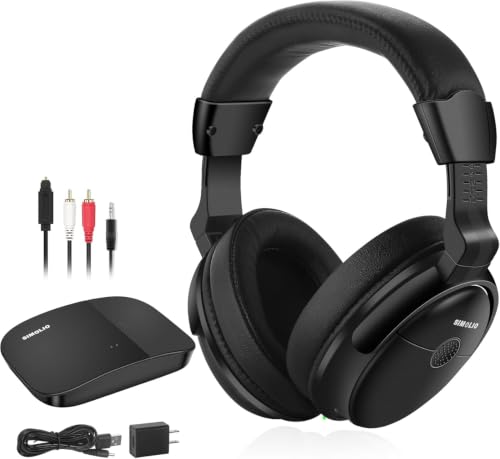
| SIMOLIO SM-823D Pro Wireless TV Headphones | Uneven hearing in each ear | Left/right balance control, 164 ft range |
| Avantree HT5009 Plus Wireless TV Headphones | Long, comfortable viewing sessions | Up to 60 hours of playtime per charge |
| SEREONIC Portable Wireless TV Speaker (BT-200) | Listening without wearing anything | Twin 5 W speakers, 100 ft range |
| SIMOLIO SM-825D Pro Wireless TV Headphones | Over-ear fit with a spare battery | Clear Dialog Mode, balance volume control |
How to Choose
Decide How the Sound Reaches Your Ears
Under-chin headsets weigh almost nothing and leave your ears open, which suits viewers who wear glasses or dislike pressure on the head. Over-ear cups seal out kitchen noise and suit film fans, but they can feel warm during a long evening. A portable speaker avoids wearing anything at all, though everyone nearby hears it too. Earbud and neckband styles sit between those extremes. Think about how many hours a day the device will be worn, whether you nap in your chair, and whether a partner watches beside you before settling on a format.
Match the Transmitter to Your TV’s Outputs
Every system here ships with a base that plugs into the television, so the outputs on your set decide what will work. Optical connections carry clean digital audio from most modern TVs, while RCA and 3.5 mm analogue outputs suit older sets. Check the back panel before ordering, and note whether a soundbar already occupies the optical port, because some transmitters offer a bypass that lets both devices share it. A TV with only an HDMI ARC socket needs an extra converter for most of these systems, so confirm that detail early rather than after the box arrives.
Weigh Latency and Wireless Technology
Infrared headsets have effectively no delay but need a clear line of sight to the transmitter, so they suit one favourite chair in one room. Radio-frequency and 2.4 GHz systems pass through walls and reach other rooms, which helps if you make tea during the news. Bluetooth kits depend on low-latency codecs to keep speech matched to lips, and a dedicated transmitter usually holds sync better than a TV’s built-in Bluetooth. Published range figures assume open space, so treat them as best cases and favour a stronger link over headline distance if your walls are thick.
Look for Controls That Fix Your Actual Problem
If one ear hears less than the other, a balance control is worth more than extra volume. Tone controls and dedicated dialogue modes lift speech out of background music, which is the complaint most viewers actually have. Large dials beat tiny buttons for arthritic hands, and a transmitter that doubles as a charging cradle removes the nightly hunt for a cable. Battery life deserves a sceptical look too: a headset that runs six hours needs a daily routine, while one rated for sixty can be charged weekly and forgotten about between films.
The 5 Best Options
TV Ears Digital Wireless Headset System (11741)
This long-running system takes the most direct route to clearer speech: an infrared transmitter feeds a two-ounce under-chin headset with volume and tone dials on the headset itself, so no menus stand between you and the dialogue. Its Voice Clarifying Circuitry pushes speech forward, and the output ceiling is high enough for viewers with substantial hearing loss. Because infrared needs line of sight, it suits a fixed seat facing the television rather than wandering between rooms, and the transmitter cradle charges two headsets.
Specs
- Transmission: infrared, mono, 2.3 MHz carrier
- Maximum output: 120 dB with Voice Clarifying Circuitry
- Headset weight: 2 oz, under-chin design
- Battery life: about 6 hours per charge; full recharge about 14 hours
- TV connections: optical, coaxial, 3.5 mm and RCA audio cords included
- Frequency response: 20–20,000 Hz
Best for: viewers with moderate to severe hearing loss who want the lightest possible headset and the strongest voice emphasis.
Watch out for: the infrared link stops at walls and furniture, so confirm your seat has an unobstructed view of the transmitter before ordering.
ASIN: B00E4JWRK4
SIMOLIO SM-823D Pro Wireless TV Headphones
The SM-823D Pro is another under-chin design, but it swaps infrared for a 2.4 GHz digital link that keeps working when you leave the room. Its standout feature is separate left and right balance control, which lets a listener with one weaker ear level the sound instead of simply turning everything up. A tone control, a mono setting for speech, and a microphone mode that amplifies room conversation round out a thoughtful control set, and the transmitter doubles as the charging dock with an optical bypass for a soundbar.
Specs
- Wireless: 2.4 GHz frequency-hopping digital link
- Range: up to 164 feet without obstacles
- Battery: replaceable 350 mAh lithium cell, about 14 hours per charge, 3-hour recharge
- TV connections: optical, RCA and 3.5 mm inputs, optical bypass output
- Controls: tone, left/right balance, mono/stereo and ambient microphone mode
- Frequency response: 20 Hz–20 kHz; signal-to-noise ratio at least 70 dB
Best for: listeners whose hearing differs between ears, and anyone who wants to keep listening while moving around the house.
Watch out for: the maker states this model is not recommended for pacemaker users, so check that warning carefully and consider the brand’s alternative model if it applies to you.
ASIN: B08DHQ7J57
Avantree HT5009 Plus Wireless TV Headphones
For viewers who prefer proper over-ear cups, the HT5009 Plus pairs padded headphones with a Bluetooth transmitter and a wireless charging dock. A Clear Voice mode and a volume boost are aimed squarely at dialogue, while the headline figure is endurance: up to sixty hours of playtime means charging becomes a weekly habit rather than a nightly one. The set is also comparatively light for an over-ear design, which matters during long films, and the transmitter passes audio through so a soundbar can stay connected for other viewers.
Specs
- Wireless: Bluetooth 5.3 with aptX Adaptive low-latency codec
- Playtime: up to 60 hours per charge
- Drivers: 40 mm; impedance 32 ohms; frequency response 20 Hz–20 kHz
- Range: up to 100 feet / 30 m through the included transmitter
- Headphone weight: about 200 g
- TV connections: optical (TOSLINK) or 3.5 mm AUX; wireless charging dock included
Best for: film and series fans who want cushioned over-ear comfort and the longest battery life in this group.
Watch out for: it cannot connect to a TV that offers only an HDMI ARC output, so verify an optical or AUX socket is free before ordering.
ASIN: B0D495BJ6H
SEREONIC Portable Wireless TV Speaker (BT-200)
The SEREONIC takes the opposite approach to a headset: a compact wireless speaker with a carry handle that you place on the arm of your chair, bringing dialogue close instead of raising the volume for the whole room. Twin drivers and a three-step tone control shape speech, and a one-hour sleep timer fades the sound down if you doze off. The base stays wired to the TV while the speaker roams, and a headphone socket on the speaker itself covers moments when you do want private listening after all.
Specs
- Speakers: 2 x 5 W Class D drivers in a portable tabletop unit
- Wireless: 2.4 GHz radio frequency link to the transmitter base
- Range: up to 100 feet in open field
- Battery: about 8 hours of listening at half volume; rechargeable and user-replaceable
- Controls: three-step tone control and one-hour sleep timer
- Size and weight: about 9 x 7 x 3.25 inches, roughly 1.7 lb
Best for: viewers who dislike wearing headsets, and households where one person wants the sound close while others listen normally.
Watch out for: the speaker is not private, so anyone in the room hears it; also confirm whether your TV needs the separate HDMI converter the maker mentions.
ASIN: B09QC4X5S4
SIMOLIO SM-825D Pro Wireless TV Headphones
The SM-825D Pro is the over-ear member of the SIMOLIO family, built around a Clear Dialog Mode that lifts voices and a spare battery that charges in the base while you listen. Separate right and left volume control carries over from its smaller sibling, which is rare in padded headphones at this level, and the 2.4 GHz link avoids the pairing steps and sync drift that can affect plain Bluetooth connections. A sharing port lets a second person plug in a wired headset, a simple touch for couples.
Specs
- Wireless: 2.4 GHz RF link with transmitter and charging base
- Battery life: up to 10 hours; about 3 hours to recharge
- Range: up to 100 feet
- Impedance: 32 ohms; frequency response 20 Hz–20,000 Hz
- Controls: Clear Dialog Mode and separate left/right volume control
- Extras: spare battery included; wired sharing port for a second listener
Best for: viewers who want padded over-ear comfort plus per-ear volume adjustment and a battery they can swap instead of waiting on a charge.
Watch out for: runtime is the shortest of the over-ear picks here, so make a habit of returning the headset to its base after each session.
ASIN: B082KN3MCW
Which One Fits Your Situation
You Watch Together but Hear Differently
When one partner needs far more volume than the other, a personal headset ends the nightly negotiation over the remote. The TV Ears Digital and the SIMOLIO SM-823D Pro both let the listener set an independent level while the TV speakers stay comfortable for everyone else, and the TV Ears transmitter can charge a second headset for couples who both want their own.
Your Hearing Is Weaker on One Side
Overall loudness will not fix a lopsided problem; it just makes the stronger ear uncomfortable. Choose a system with genuine left and right balance control, which means the SIMOLIO SM-823D Pro in its under-chin form or the SM-825D Pro if you prefer padded cups. Set the balance once with a familiar newsreader’s voice, then adjust volume day to day.
You Cannot Stand Wearing Headphones
Some viewers simply will not keep a headset on, and a device that gets removed helps nobody. The SEREONIC portable speaker sits beside your chair instead, close enough that dialogue arrives clearly at a modest level. It also suits viewers with hearing aids who find earbuds awkward, since nothing needs to sit in or on the ear at all.
You Watch Long Films and Hate Charging
If your evenings run to double features, battery endurance decides whether the device is ready when you are. The Avantree HT5009 Plus stretches to sixty hours between charges and rests on a wireless dock, so returning it to its place is the whole routine. Shorter-runtime headsets are fine for an hour of news, but they punish forgetfulness.
Common Mistakes
- Buying for maximum volume when the real problem is dialogue buried under music and effects; a voice-clarifying mode matters more than raw loudness.
- Skipping the check of your TV’s audio outputs, then discovering the only free socket is HDMI ARC, which most transmitters here cannot use directly.
- Choosing infrared for a listener who moves between rooms, or Bluetooth without a low-latency transmitter for a viewer who is sensitive to lip-sync drift.
- Ignoring medical warnings in the listing, such as the pacemaker caution attached to some 2.4 GHz headsets, instead of checking them before ordering.
- Forgetting the charging routine: a headset left on the arm of the sofa is flat by the weekend, while one returned to its cradle never is.
Frequently Asked Questions
Will a TV listening device work with my hearing aids?
It depends on the style you choose. Under-chin headsets with earbuds usually sit alongside smaller aids, while over-ear cups can cause feedback with some models. The portable speaker avoids the issue entirely because nothing touches the ear. Check the maker’s notes on aid compatibility for the exact model, and favour a design you can return if the fit fights your aids.
Can other people still hear the TV while I use one?
With most transmitter systems, yes. Connecting through the optical output usually leaves the TV speakers or a soundbar working for everyone else, and several transmitters here include a bypass for exactly that arrangement. Analogue headphone sockets are the exception on some TVs, which mute the speakers when used, so check your set’s behaviour before relying on shared listening.
Why does the sound drift out of sync with the picture?
Delay creeps in when audio takes a slow wireless path, most often plain Bluetooth without a low-latency codec. Infrared and dedicated 2.4 GHz systems avoid it by design, and Bluetooth kits with aptX Adaptive or FastStream through their own transmitter keep speech matched to lips. If sync bothers you, pick a system whose transmitter, not the TV, handles the wireless link.
Do these devices replace hearing aids?
No. A TV listening device only improves one sound source, the television, by delivering its audio directly and shaping the dialogue. It does nothing for conversation, doorbells, or the telephone, and it is not fitted to your hearing the way an aid is. Treat it as a targeted comfort for viewing, and keep up with proper hearing care separately.
More from Amazon
Programs that pair well with the guide above. Offers and eligibility are set by Amazon and may change.
Collect the home and kitchen items you want in one registry that guests can shop from.
Create a wedding registrySet up recurring deliveries of everyday items on eligible products. Terms and savings are set by Amazon.
Explore Subscribe & SaveFree shipping on eligible items, Prime Video and more. Eligible new members can start with a free trial.
Start a Prime free trialAudiobooks and podcasts to listen to on the go. Eligible new members can start with a free trial.
Try Audible freeAs an Amazon Associate we earn from qualifying purchases.




Write Your Review
No reviews yet. Be the first to share your experience!