

Key takeaways
- People who want one sled for both lower-body strength and conditioning.
- Athletes training forward pushes, backward drags, lateral pulls, and heavy marches.
- Users with access to turf, rubber flooring, concrete, or a suitable outdoor surface.
Best Weight Sleds for Strength and Conditioning
The best weight sled for most athletes is a steel push-and-pull sled with replaceable plastic skis, two low tow points, and room for at least 300 lb of plates; choose a compact drag sled instead if you have limited storage or mainly train pulling.
Best weight sleds by training situation
| Best for | Recommended sled type | Useful specifications | Why it fits |
|---|---|---|---|
| Small home gym or occasional use | Compact drag sled | 15–35 lb frame; 200–300 lb capacity; single tow point | Stores easily and works with a harness, belt, or strap |
| General strength and conditioning | Two-ski push/pull sled | 45–75 lb frame; 300–500 lb capacity; high and low handles | Supports pushing, backward drags, forward pulls, and heavy resistance work |
| Frequent commercial-gym use | Heavy-duty steel sled with replaceable skis | 60–100 lb frame; 500 lb or more capacity; multiple tow points | Better suited to repeated loading, group training, and outdoor use |
| Grass, turf, and mixed outdoor surfaces | Wide-ski sled with rounded or replaceable runners | 4–6 inch-wide runners; powder-coated steel; low tow point | Spreads load and reduces the chance of digging into softer ground |
| Mostly pulling or walking conditioning | Waist-harness drag sled | 10–25 lb frame; 200–400 lb capacity; swiveling tow attachment | Usually quieter, lighter, and easier to transport than a push sled |
1. Best all-around design: a two-ski push-and-pull sled
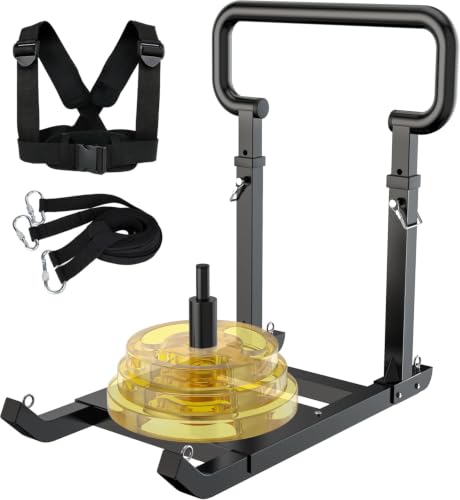
A conventional two-ski sled is the strongest all-purpose choice because it can be pushed from upright handles and pulled from a harness, belt, or rope. Look for a frame made from 11-gauge or thicker steel, welded plate storage posts, and at least two tow points positioned at different heights.
Our top picks


As an Amazon Associate we earn from qualifying purchases at no extra cost to you. Ratings are shown as listed on Amazon.
A low tow point keeps the sled tracking close to the ground during forward drags. A higher attachment point can make the sled easier to steer and more comfortable for backward or angled pulls. If the sled has only one high tow point, it may work well for pulling but can lift or wobble when heavily loaded.
For most home users, a capacity of 300 to 500 lb is more useful than an extremely heavy frame. A typical 45 lb sled loaded with 180 lb of plates already creates a substantial conditioning challenge on turf. A heavier 500 lb-plus rating makes sense for a facility, a strong athlete, or very low-speed strength work.
Who should choose it?
- People who want one sled for both lower-body strength and conditioning.
- Athletes training forward pushes, backward drags, lateral pulls, and heavy marches.
- Users with access to turf, rubber flooring, concrete, or a suitable outdoor surface.
Representative products in this category include the Rogue Dog Sled 1.2 and similar heavy-duty two-ski sleds from established strength-equipment manufacturers. Compare the exact handle, ski, and tow-point configuration rather than assuming every “dog sled” has the same capabilities.
2. Best for limited space: a compact drag sled
A compact drag sled is the practical choice when storage, transport, and noise matter more than pushing versatility. These sleds generally have a flat steel base, one or two loading posts, and a central tow loop. They can be pulled with a harness, dip belt, or long strap.
The trade-off is important: a drag sled without upright handles is not a true push sled. You can sometimes push it by attaching a strap and leaning into the strap, but this is less stable and less comfortable than using dedicated handles. Choose this design if pulling is your main objective.
A lighter frame is not automatically inferior. When the sled is used for walking drags, the athlete supplies much of the resistance through the plates. A 15 to 25 lb frame is easier to carry to a field and often causes less damage to flooring when turned or stored.
What to inspect
- A swiveling or rounded tow ring that allows the sled to follow changes in direction.
- A strap or rope long enough to keep your feet clear of the sled.
- Plate posts that accept standard Olympic plates if you already own them.
- Rounded ski edges or a protective bottom surface for turf and rubber floors.
3. Best for frequent use: a heavy-duty sled with replaceable runners
For several sessions per week, the runners matter as much as the frame. Steel skis can be durable but may mark indoor flooring and create considerable noise. Plastic runners, often made from high-density polyethylene or UHMW-PE, are quieter and glide more consistently on turf. They eventually wear, but replaceable runners are preferable to replacing the entire sled.
Heavy-duty models typically use thicker steel, braced loading posts, and a wider base. These features reduce flex when the sled is loaded heavily. They also increase the unloaded weight, footprint, and cost, so they are unnecessary for someone performing light drags once a week.
Rogue, Torque Fitness, Titan Fitness, and REP Fitness all sell sled-style strength equipment or related conditioning products, but configurations vary by model and revision. Check the current manufacturer specification for included handles, runner material, maximum loading, and whether replacement parts are available.
Surface compatibility: the decision most buyers miss
A sled that glides well on artificial turf may behave poorly on concrete, asphalt, grass, or rubber flooring. Surface friction changes the effective load, while sharp or narrow runners can cut into soft surfaces.
| Surface | Preferred runner | Practical guidance |
|---|---|---|
| Artificial turf | Plastic or rounded steel skis | Usually the most predictable surface; inspect for turf damage |
| Rubber gym flooring | Plastic skis or protective skid pads | Use moderate loads and avoid pivoting under heavy resistance |
| Concrete | Replaceable plastic runners | Expect high noise and rapid runner wear; avoid dragging indoors without permission |
| Asphalt | Wide, durable runners | Very abrasive; use a dedicated outdoor sled or inexpensive replaceable runners |
| Natural grass | Wide skis with rounded edges | Best when the ground is firm; wet or soft ground greatly increases resistance |
Push-only, pull-only, or both?
Push-only sleds have upright handles and are convenient for short, powerful efforts. They work well for forward drives, but they do not automatically provide a comfortable method for harness dragging. Pull-only sleds are simpler and often lighter, but they lack the bracing and hand position needed for effective pushes.
A dual-purpose sled should have handles at a height that lets you maintain a neutral spine without crouching excessively. It should also include a low tow point near the front of the frame. If the tow point is centered too high, the front may lift under load; if it is too low and fixed, the sled may catch on uneven ground.
For mixed training, prioritize attachment options over decorative frame features. A useful arrangement is high handles for pushing, a low front ring for forward pulls, and side or rear attachment points for backward and lateral work.
How much weight do you actually need?
Start with the resistance that allows steady movement without sprinting into a breakdown in posture. For a basic estimate, add the frame weight to the plates, then treat the result as a starting load rather than a universal strength measure:
Example: a 50 lb sled plus two 45 lb plates equals 140 lb of total equipment mass. On smooth turf, this may be manageable for repeated 20-yard pushes. On grass or rough asphalt, the same 140 lb can feel substantially heavier because surface friction rises. Increase plates only after you can control the sled through the entire distance.
Capacity is not a target. A 500 lb rating means the frame is designed to support that load under the manufacturer’s conditions; it does not mean every surface, tow strap, or athlete should use 500 lb.
Ownership costs and maintenance
The first wear point is usually the runner or skid surface, especially on asphalt and concrete. Tow straps can fray, carabiners can deform, and powder coating can chip where plates contact the frame. These are normal consumables, but replacement availability should influence your purchase.
- Brush off grit after outdoor sessions; trapped sand accelerates runner wear.
- Wipe moisture from steel and store the sled under cover to reduce rust.
- Inspect welds, tow rings, handles, and plate posts before heavy sessions.
- Do not drag a loaded sled sideways unless it is designed for lateral movement.
- Use a protective mat when loading plates on finished floors.
- Replace a frayed strap rather than tying knots into the damaged section.
Bottom line
Choose a compact drag sled for inexpensive, space-efficient pulling; choose a two-ski sled with high handles and multiple tow points for the best all-around training; and choose a heavy-duty model with replaceable plastic runners for frequent use or mixed surfaces. Before buying, verify the real load capacity, runner material, tow-point height, included attachments, and compatibility with the surface where you will train. Those details determine whether a sled becomes a versatile conditioning tool or an awkward piece of steel that stays in storage.



Write Your Review
No reviews yet. Be the first to share your experience!