

Key takeaways
- Unplug the device before cleaning it.
- Wipe silicone, faux leather, and plastic with a lightly damp cloth and mild soap.
- Do not saturate the motor housing or spray cleaner directly into openings.
- Wash removable covers according to their label and let them dry completely before refitting them.
- Keep massage heads free of hair and store the device without sharply folding its cable.
- Do not share a fabric-covered device without cleaning the contact area between users.
Best Neck Massagers for Everyday Tension Relief
The best neck massagers for everyday tension relief are wraparound shiatsu models for strong, targeted pressure, collar-style devices for discreet low-intensity use, handheld massagers for flexible coverage, and pillow-style models for gentle relaxation with minimal effort.
Your choice should depend less on the number of massage modes and more on four practical questions: how much pressure you prefer, whether you need to carry it, how precisely you want to control heat, and how easily the surfaces can be cleaned. The comparison below focuses on typical 2026 product specifications rather than advertising claims; exact dimensions and runtime vary by model.
Our top picks


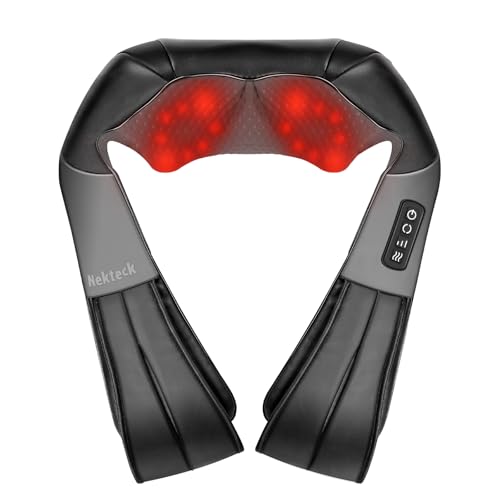
As an Amazon Associate we earn from qualifying purchases at no extra cost to you. Ratings are shown as listed on Amazon.
Quick comparison of neck-massager types
| Type | Typical weight | Typical power or runtime | Intensity | Heat control | Cleaning practicality | Best suited to |
|---|---|---|---|---|---|---|
| Collar-style | 0.2–0.5 lb | Rechargeable; 60–180 minutes per charge | Low to medium | Usually no heat; some offer gentle warming | Good; wipeable silicone or fabric exterior | Desk use, travel, and people who dislike kneading pressure |
| Wraparound shiatsu | 2.5–4.5 lb | AC adapter; continuous sessions while plugged in | Medium to high | Usually one heat setting, around 100–113°F | Fair; textured covers and straps need careful wiping | Deep pressure and short, focused sessions at home |
| Handheld | 1.5–3.5 lb | AC or rechargeable; 45–120 minutes cordless | Adjustable from low to high | Rare; depends on attachment | Very good if attachments detach and can be washed | Neck, shoulders, upper back, arms, and legs |
| Pillow-style | 2–5 lb | AC adapter; designed for stationary use | Low to medium | Often one selectable heat setting | Good only if the outer cover is removable and washable | Gentle relaxation while seated or lying down |
These figures are useful for comparing categories, not guarantees. A lighter device is not automatically weaker, and a higher motor speed does not necessarily produce more comfortable pressure.
Best neck massagers by situation
Best for strong pressure: wraparound shiatsu
A wraparound shiatsu massager is the most suitable choice when you want rotating nodes to work around the sides and back of the neck. Its arm straps let you add or reduce pressure by pulling down, which is more responsive than fixed-speed vibration.
Choose one with forward and reverse rotation, a session timer of about 10–15 minutes, and a heat switch separate from the massage control. Independent heat control matters because warming is not comfortable for everyone, and you may want pressure without added warmth. The trade-off is size: most models require a wall outlet, make more motor noise than collar devices, and can feel too intense if positioned directly over the front or side of the neck.
Best for discreet, portable use: collar-style
Collar-style massagers generally use vibration, electrical stimulation, or small moving contact points rather than large kneading nodes. They fit under a shirt more easily, weigh less than a pound in many cases, and are the most convenient category for a desk drawer or carry-on bag.
Look for several intensity levels, physical buttons, automatic shutoff, and a flexible surface that sits comfortably without being tightened. If a model uses electrical stimulation, read the safety instructions carefully and treat it as a different sensation from mechanical massage. Collar devices are usually a poor choice if you want deep kneading or broad shoulder coverage.
Best for one device throughout the body: handheld
Handheld massagers provide the widest coverage. You can use a compact head around the upper trapezius muscles, then change position for the shoulders, back, or legs. They are also easier to stop immediately if a particular area feels uncomfortable.
The main disadvantage is technique. Holding a 2–3-pound device above your shoulder can fatigue your arm, and it is easy to press too hard when trying to reach a difficult spot. A model with a long handle, a balanced grip, multiple speed levels, and a 6–8-foot power cord is generally easier to control than a small but top-heavy unit. Detachable washable heads are preferable to permanently attached fabric pads.
Best for gentle relaxation: pillow-style
Pillow-style massagers are designed to support the head or upper back while rotating nodes move beneath the neck. They require little effort and can be useful when you prefer mild pressure rather than manually positioning a device.
Check the pillow’s height before buying. A thick cushion can push the head forward, while a low cushion may not maintain contact. A removable cover with a zipper is a major ownership advantage. Without one, sweat, hair products, and skin oils accumulate in seams that are difficult to clean.
Decision matrix: match the device to your routine
| Your situation | Best match | Why | What to avoid |
|---|---|---|---|
| Under $50 budget | Basic collar or compact pillow | Fewer moving parts and lower replacement cost | Unusually cheap shiatsu units with no timer or warranty information |
| Frequent desk use | Rechargeable collar | Light, quiet, and easy to store | Large plug-in units that require a dedicated chair |
| Strong-pressure preference | Wraparound shiatsu | Adjustable strap pressure and rotating nodes | Small vibration-only collars |
| First-time user | Pillow-style or low-intensity collar | Easier to tolerate and simpler to stop or reposition | High-speed handhelds and rigid kneading mechanisms |
| Small living space | Collar or handheld | Fits in a drawer and serves more than one location | Bulky pillow units with dedicated storage needs |
| Several users share it | Handheld with removable washable attachments | Contact surfaces are easier to clean between users | Non-removable fabric covers |
Heat, portability, and controls: details that change the decision
Heat should be treated as an optional comfort feature, not proof of better massage. A useful design has a separate heat button, a visible indicator, and automatic shutoff. One fixed heat level is common; models advertising multiple temperatures should state whether those are actual temperature settings or simply different timing presets.
For portability, calculate more than the listed weight. Include the charger, storage pouch, and any required controller. A 0.8-pound cordless device may be more practical than a 2-pound model if it recharges by USB-C, but cordless convenience is limited if the battery lasts only 45 minutes. For example, a device rated for 90 minutes and used for 10 minutes per day provides approximately nine sessions between charges. Real runtime may be lower at maximum intensity or with heat enabled.
Physical buttons are usually preferable when the device is behind your neck. A remote can be convenient for pillow-style use, but it adds another item to misplace. A 10–15-minute automatic timer helps prevent absent-mindedly extending a session.
Cleaning and durability: what wears out first
The first parts to show wear are commonly the fabric around the contact points, elastic straps on wraparound models, charging ports on cordless units, and seams around pillow covers. Rotating massage nodes may also become noisy if hair or dust enters the mechanism.
- Unplug the device before cleaning it.
- Wipe silicone, faux leather, and plastic with a lightly damp cloth and mild soap.
- Do not saturate the motor housing or spray cleaner directly into openings.
- Wash removable covers according to their label and let them dry completely before refitting them.
- Keep massage heads free of hair and store the device without sharply folding its cable.
- Do not share a fabric-covered device without cleaning the contact area between users.
A removable washable cover is generally more valuable than an extra massage mode. For regular use, also check the warranty length, availability of replacement straps or covers, and whether the battery can be replaced or serviced. These details determine ownership value after the novelty of the first few weeks has passed.
How to use a neck massager more comfortably
- Start with the lowest intensity and no heat for the first session.
- Place the device on the back and sides of the neck, not across the front of the throat.
- Use the built-in timer, usually 10–15 minutes, rather than extending the session because the sensation feels pleasant.
- Keep the device moving or use its intended rotating pattern; do not force a stationary node into a painful point.
- Stop if you experience sharp pain, numbness, dizziness, skin irritation, or unusual symptoms.
- Clean the contact surfaces and allow any damp cover to dry before storing the device.
People with significant neck pain, recent injury, neurological symptoms, implanted electronic devices, circulation concerns, or other medical conditions should ask a qualified healthcare professional whether massage equipment is appropriate. These devices are for general comfort and relaxation, not diagnosis or treatment.
Bottom line
Choose a wraparound shiatsu model for the strongest home pressure, a collar-style model for portability and discreet daily use, a handheld model for versatile whole-body coverage, and a pillow-style model for gentle, hands-free relaxation. Across all four categories, prioritize controllable intensity, independent heat control, automatic shutoff, washable contact surfaces, and a design you will actually use often.





Write Your Review
No reviews yet. Be the first to share your experience!