

Key takeaways
- For a first massager or occasional use: Look for a compact unit with two or three speeds, a simple round attachment, and a weight you can comfortably hold with one hand. The Theragun Mini is a practical example if portability is the priority; a less expensive compact percussion massager may suit you if you do not need a premium travel design.
- For regular post-workout use at home: A midweight model with at least three speeds, a comfortable handle, and a clear battery indicator is a better balance than the smallest or most powerful option. The Hypervolt 2 is one example to compare.
- For greater control and longer sessions: Consider a model with more speed settings and a grip that lets you reach your back or shoulders without twisting your wrist. The Theragun Prime’s triangular handle can offer different hand positions, though its shape is a matter of preference.
- For frequent, varied use: A feature-rich model such as the Theragun PRO Plus may be worth considering if you will use its additional modes. If you only want percussion, those extras may add cost and weight without improving your day-to-day experience.
- For shared household use: Favor an easy-to-clean body, replaceable or washable attachments, and enough battery capacity that the device is ready when another person needs it. Check the manual for which parts may be washed; do not immerse the massager itself.
The best handheld massagers for muscle relief depend on how much pressure you need, how often you’ll use the device, and whether weight, noise, or price matters most: choose a compact model for occasional use, a midrange percussion massager for regular recovery, or a higher-force model if you need more pressure without the motor stalling.
Specifications vary by model and can change, so treat the figures below as a practical comparison of commonly published ranges—not a substitute for checking the exact model’s current manual and product specifications. Stall force is especially inconsistent: some brands publish a force figure, while others do not. A device’s maximum speed alone doesn’t tell you how much pressure it can maintain.
Our top picks
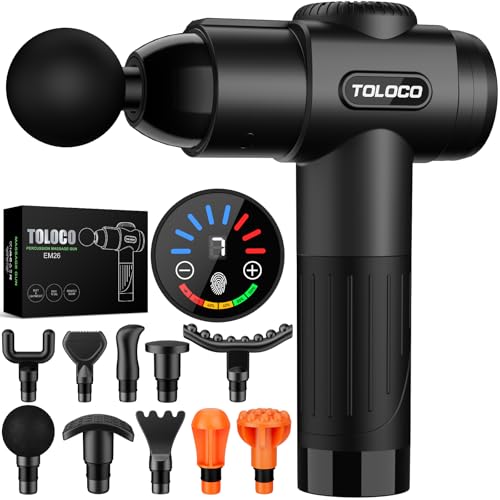
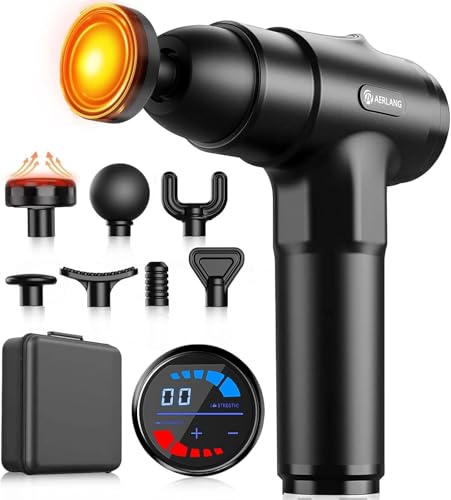

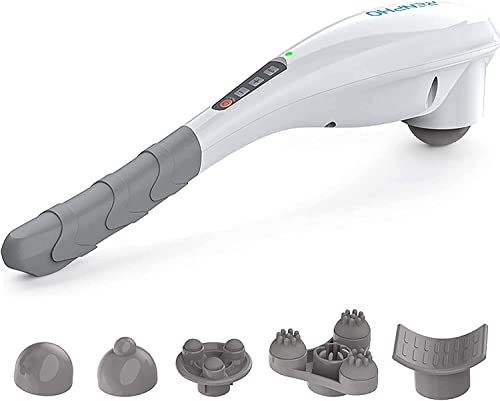
As an Amazon Associate we earn from qualifying purchases at no extra cost to you. Ratings are shown as listed on Amazon.
Quick comparison: match the massager to the job
| Type or example | Weight | Speed settings | Battery life | Best fit |
|---|---|---|---|---|
| Theragun Mini 2nd Generation | About 1.5 lb | 3 speeds; up to about 2,400 percussions per minute | Up to about 120 minutes | Travel, smaller muscles, and users who prioritize compact size |
| Hyperice Hypervolt 2 | About 1.8 lb | 3 speeds; up to about 2,700 percussions per minute | Up to about 3 hours | Regular home use and a quieter-feeling percussion option |
| Theragun Prime | About 2.2 lb | 5 speeds; up to about 2,400 percussions per minute | Up to about 120 minutes | Users who want more speed choices and an angled grip |
| Theragun PRO Plus | About 3 lb | Multiple percussive speeds; additional treatment modes | Varies by mode and use | Frequent users willing to trade portability for more features |
Published weights, speed ranges, and runtime may differ by generation and market. “Up to” battery figures are typically measured under favorable conditions; higher pressure, longer sessions, and additional modes can reduce runtime. Brands do not all report stall force in comparable units, so the table avoids treating unverified or non-equivalent force claims as a head-to-head result.
Choose by situation, not by the biggest number
- For a first massager or occasional use: Look for a compact unit with two or three speeds, a simple round attachment, and a weight you can comfortably hold with one hand. The Theragun Mini is a practical example if portability is the priority; a less expensive compact percussion massager may suit you if you do not need a premium travel design.
- For regular post-workout use at home: A midweight model with at least three speeds, a comfortable handle, and a clear battery indicator is a better balance than the smallest or most powerful option. The Hypervolt 2 is one example to compare.
- For greater control and longer sessions: Consider a model with more speed settings and a grip that lets you reach your back or shoulders without twisting your wrist. The Theragun Prime’s triangular handle can offer different hand positions, though its shape is a matter of preference.
- For frequent, varied use: A feature-rich model such as the Theragun PRO Plus may be worth considering if you will use its additional modes. If you only want percussion, those extras may add cost and weight without improving your day-to-day experience.
- For shared household use: Favor an easy-to-clean body, replaceable or washable attachments, and enough battery capacity that the device is ready when another person needs it. Check the manual for which parts may be washed; do not immerse the massager itself.
What matters in the specifications
Stall force and useful pressure
Stall force is the pressure a percussion device can tolerate before its motor slows or stops. More can be useful when treating large muscle areas, but it is not a measure of quality by itself. A high-force device can feel uncomfortable or be difficult to control, especially for a new user. If a brand does not publish stall force, look for an explicit force specification in the manual or ask the manufacturer rather than inferring it from the motor’s speed.
During use, let the head rest lightly against the muscle and move it slowly. Pressing hard to force a sensation can make a massager stall and may irritate the area. For a first device, controllable pressure and a secure grip often matter more than the highest advertised force.
Speed, intensity, and attachments
Speed describes how quickly the head moves; intensity is also affected by stroke length, pressure, attachment shape, and how the device is held. Three well-spaced speeds are enough for many people. More settings help fine-tune comfort, but a long list of modes is not automatically an advantage.
- Round or ball head: A versatile starting point for broad muscle areas.
- Flat head: A broader, firmer contact surface; use light pressure and avoid pressing directly on bones.
- Fork head: Designed to sit around a narrow structure, but should not be used to press on the spine or other bony areas.
- Bullet head: Concentrates contact in a small area. It can feel intense, so it is usually not the best attachment for beginners or sensitive areas.
- Soft or padded head: Useful when a firmer attachment feels too harsh, depending on the model.
More attachments are useful only if they fit your intended use and can be stored and cleaned properly. Check whether replacement heads are available; an attachment that wears, cracks, or goes missing should not make the whole device unusable.
Battery, weight, grip, and noise
Compare runtime with your actual session length rather than assuming you need the largest battery. As a planning example, a massager rated for 120 minutes of ideal runtime could provide roughly 20 sessions of six minutes each before recharging. Actual results may be lower with firm pressure, high speeds, or other operating modes.
Weight becomes more noticeable when your arm is raised to reach your shoulders or back. If possible, prioritize a handle that supports more than one grip position and a trigger you can operate without squeezing hard. Noise is difficult to compare across brands because measurement methods and distances differ. Look for independent sound measurements taken at a stated distance, or choose a model described as quiet only after checking whether that claim applies at every speed.
Ownership details that affect value
For an estimate of cost per use, divide the purchase price by the number of sessions you realistically expect. For instance, a hypothetical $150 device used three times a week for one year works out to about $0.96 per session: $150 divided by 156 sessions. This excludes charging costs and any replacement parts, and the result rises if the massager ends up in a drawer.
Before buying, check the warranty term, charging connector, battery replacement policy, and availability of compatible attachment heads. The battery is a long-term wear item, while heads can loosen, split, or collect residue. Wipe attachments after use with a cloth and a cleaner approved by the manufacturer, let them dry fully, and inspect them periodically. Do not use solvents or soak foam or electronic components unless the manual explicitly allows it. A device that overheats, develops a damaged cable, or makes a new grinding sound should be switched off and checked according to the manufacturer’s guidance.
Bottom line
For portability, compare compact models such as the Theragun Mini. For regular home use, balance a manageable weight, comfortable grip, three or more useful speeds, and a battery that covers several sessions; the Hypervolt 2 and Theragun Prime are examples in that comparison set. Choose a heavier, feature-rich option only if its added control or modes justify the extra cost and bulk. Since specifications and regional versions can change, verify the exact model’s weight, runtime, attachments, and warranty before purchasing.
Percussion massagers are general wellness devices, not a diagnosis or treatment for an injury. Avoid using one on injured, swollen, numb, or unusually painful areas, and ask a healthcare professional whether it is appropriate if you have a medical condition or are unsure where it is safe to use.




Write Your Review
No reviews yet. Be the first to share your experience!