

Key takeaways
- Inspect every tooth and pocket before each job. Replace damaged fasteners rather than continuing with a loose tooth.
- Grease bearings and pivot points at the intervals specified in the manual; insufficient lubrication can overheat or misalign the wheel.
- Clean chips and soil from the engine cooling area, hydraulic cooler, guards, and track assemblies after use.
- Check belt tension, hydraulic hoses, tire or track condition, and wheel-guard fasteners before starting.
- Keep the cutter wheel out of buried soil and gravel whenever possible. Start with the exposed wood and excavate around deep roots instead of forcing the wheel downward blindly.
- Use hearing, eye, foot, and protective clothing appropriate for high-velocity chips and machine noise.
Best Stump Grinders for Fast Yard Clearing
The best stump grinders for most homeowners are compact walk-behind machines with a 12–18 inch cutting depth, while frequent users and contractors will clear large or numerous stumps faster with a self-propelled track grinder offering roughly 20–30 inches of depth.
The right choice depends less on maximum horsepower than on the stump’s diameter, root spread, access route, soil conditions, transport equipment, and how often you expect to use the machine. A small grinder can be easier to position and cheaper to hire, but it may take several times longer on a large hardwood stump.
Our top picks


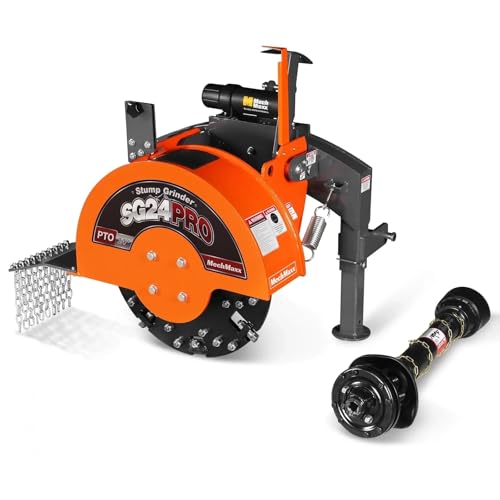

As an Amazon Associate we earn from qualifying purchases at no extra cost to you. Ratings are shown as listed on Amazon.
Best stump grinders by situation
| Situation | Best machine type | Useful target specification | Why it fits |
|---|---|---|---|
| One or two small residential stumps | Compact walk-behind grinder | 13–15 hp, 8–12 inch cutter wheel, 10–14 inch cutting depth | Fits through narrow gates and is simpler to tow or load |
| Several medium stumps each year | Heavy-duty walk-behind grinder | 25–35 hp, hydraulic controls, 16–20 inch depth | Balances productivity, maneuverability, and ownership cost |
| Large hardwood stumps or extensive roots | Self-propelled track grinder | 35–75 hp, 20–30 inch depth, hydraulic side shift | More stability and cutting capacity in difficult ground |
| Commercial daily use | Tracked professional grinder | 50 hp or more, replaceable carbide teeth, remote controls | Reduces operator fatigue and speeds repeated repositioning |
| Occasional use with no storage space | Rental-grade grinder | Trailerable unit under about 1,500 lb | Avoids maintenance and storage costs between projects |
Walk-behind versus tracked stump grinders
Compact walk-behind grinders
Compact machines are usually the best value for a homeowner clearing a single stump. Many fit through a 30–36 inch gate, although the machine’s actual width must be checked at the widest point, including the cutting wheel guard. Their relatively low weight makes them easier to move across established lawns and load onto a suitable trailer or ramp.
The trade-off is cutting speed. A small wheel and lower-powered engine may require repeated passes, especially through dense oak, maple, or other hardwood. Walk-behind models also demand more physical effort because the operator must control the machine’s position and often reposition it manually.
Heavy-duty walk-behind grinders
A 25–35 horsepower machine is a useful middle ground for property managers, landscapers, and homeowners with several trees to remove. Hydraulic drive and hydraulic cutter-wheel movement make a noticeable difference: they let the operator sweep across the stump smoothly instead of repeatedly lifting and forcing the machine by hand.
These grinders are still more compact than most tracked units, but their weight commonly reaches 1,000–1,500 pounds. Confirm that your trailer, ramps, vehicle, and storage surface can handle the combined load. A machine that cannot be unloaded safely is not a practical bargain.
Tracked grinders
Tracked models are the fastest choice for large stumps, sloping ground, and jobs involving multiple trees. Tracks spread the machine’s weight over a larger area than tires, improving stability and reducing the likelihood of getting stuck in soft soil. Some models also have hydraulic tracks that allow the operator to move through gates and then widen the undercarriage for better stability.
The disadvantages are higher purchase or rental cost, greater transport weight, more complicated hydraulic systems, and a larger footprint. Tracks can still damage wet lawns, particularly during tight turns. Use boards or ground protection when conditions are soft.
Cutting depth matters more than maximum engine power
Look at both below-ground depth and sideways reach. A grinder rated to cut 20 inches below grade may remove the main stump effectively, but shallow side reach can leave large surface roots that require additional digging. A swing or side-shift function allows the cutter wheel to cover more of the stump without moving the entire machine.
For replanting or building over the area, grinding 6–12 inches below grade is often enough for surface clearance, but roots may continue beyond the visible stump. For a lawn repair, deeper grinding gives room for soil and turf. For a new structural footing, drainage installation, or utility work, stump grinding is not a substitute for excavating and inspecting the area.
Do not judge productivity from cutting depth alone. A narrow wheel with fewer teeth may reach deeply but remove material slowly. Ask about cutter-wheel diameter, wheel width, tooth arrangement, hydraulic flow, and the availability of replacement teeth.
Wheel design and teeth: the parts that control speed
Cutter wheels use replaceable carbide-tipped teeth. Teeth arranged around the wheel need to cut cleanly on the forward sweep, return stroke, and side-to-side movement. A wheel with an aggressive tooth pattern can clear material quickly, but replacement teeth may cost more and require more frequent inspection.
Traditional pockets and teeth are relatively easy to replace individually. Some modern systems use specialized tooth holders or alternating cutting profiles to improve performance in hardwood and rocky soil. That can be useful, but only if replacement parts are readily available.
Expect teeth to wear first, followed by tooth pockets, bearings, belts or hydraulic components, and eventually the wheel itself. Soil, gravel, nails, fencing wire, and buried landscaping edging can damage carbide tips quickly. Clear the area with a metal detector where appropriate, and never assume a stump is free of embedded objects.
Power source: gasoline, diesel, or battery
Gasoline engines dominate compact and mid-size grinders because they provide a strong power-to-weight ratio and are easy to refuel during a long job. Typical gasoline classes range from about 13 to 35 horsepower. Diesel is more common in larger commercial machines, where fuel efficiency, torque, and long operating life matter more than low weight.
Battery-powered grinders produce less noise and no exhaust at the work position, making them attractive near homes, schools, and enclosed sites. However, cutting hardwood consumes energy quickly. A battery unit may be suitable for small stumps and short jobs, but confirm the manufacturer’s rated runtime under cutting load rather than relying on no-load motor time. Budget for additional battery packs or charging infrastructure if the machine must work continuously.
Transport, access, and site preparation
Measure the narrowest gate, path, doorway, and turning area before choosing a machine. Add at least 2 inches of clearance on each side for a controlled passage; more is preferable when the route is uneven. Check whether the cutter wheel, guard, or control handles make the stated machine width larger in practice.
Transport weight includes fuel, accessories, ramps, and any removable ballast. A grinder weighing 1,200 pounds can exceed a small trailer’s usable payload once equipment and debris are added. Verify the trailer’s gross vehicle weight rating, tie-down points, brake requirements, and the towing capacity of the vehicle.
Before cutting, identify irrigation lines, low-voltage lighting, drainage pipes, and utility services. Mark the stump’s visible roots, remove stones and loose branches, and establish an exclusion zone. The cutter throws chips with considerable force, so keep people, pets, vehicles, and windows away from the work area.
Durability and ownership costs
For occasional use, the lowest purchase price is not always the lowest cost. Consider a simple ownership calculation: if a used or entry-level grinder costs $4,000 and you expect to clear ten stumps, the equipment cost alone is $400 per stump before fuel, teeth, transport, maintenance, and resale value. Renting may be less expensive for a single project; ownership becomes more attractive when usage is frequent or access makes contractor service expensive.
Prioritize a protected engine, greasable bearings, robust wheel guards, accessible service points, and a manufacturer or dealer that stocks teeth, pockets, belts, filters, and hydraulic parts. A powerful machine that sits idle while waiting for a special tooth holder is less productive than a smaller machine with readily available consumables.
Maintenance that prevents expensive failures
- Inspect every tooth and pocket before each job. Replace damaged fasteners rather than continuing with a loose tooth.
- Grease bearings and pivot points at the intervals specified in the manual; insufficient lubrication can overheat or misalign the wheel.
- Clean chips and soil from the engine cooling area, hydraulic cooler, guards, and track assemblies after use.
- Check belt tension, hydraulic hoses, tire or track condition, and wheel-guard fasteners before starting.
- Keep the cutter wheel out of buried soil and gravel whenever possible. Start with the exposed wood and excavate around deep roots instead of forcing the wheel downward blindly.
- Use hearing, eye, foot, and protective clothing appropriate for high-velocity chips and machine noise.
Final buying recommendation
Choose a compact walk-behind grinder when gate width, storage, and occasional use matter most. Choose a 25–35 horsepower hydraulic walk-behind model when you need a versatile machine for repeated residential work. Choose a tracked grinder when stump size, deep cutting, steep or soft ground, and daily productivity justify the extra transport and ownership demands.
The best stump grinders are not simply the machines with the largest engines. Match cutting depth and wheel design to the stump, confirm the machine fits through the site, calculate the real transport and maintenance burden, and select a model with durable components and easily sourced replacement teeth.



Write Your Review
No reviews yet. Be the first to share your experience!