

Key takeaways
- Compare breathing exercisers and spirometers on resistance range, ease of cleaning and feedback markers to rebuild lung strength during home recovery.
As an Amazon Associate we earn from qualifying purchases.
Disclosure: This article contains affiliate links. If you buy through these links, we may earn a commission at no extra cost to you.

Breathing feels automatic until an illness, a hospital stay, or weeks of reduced activity make every deep breath feel shallow. During home recovery, the breathing muscles weaken quickly, and rebuilding them takes deliberate, repeated practice. Breathing exercisers give that practice structure. Some add adjustable resistance so the inspiratory and expiratory muscles work harder with each breath, much like light weights train an arm. Others, called incentive spirometers, reward slow, deep inhalation with a rising piston or marker that shows how much air you moved. Both approaches fit a home routine, but they train in different ways.
This guide compares five established options across both families. Each pick was chosen for a verifiable identity, a clear feedback method, and a cleaning routine that works at a kitchen sink. Always follow the plan your own clinician gave you, and stop and seek advice if a session brings dizziness, chest pain, or unusual breathlessness.
How to Choose a Breathing Exerciser for Home Recovery
Start by matching the device type to your goal. If your care team asked you to practise slow, sustained, deep breaths and watch your inspired volume climb, an incentive spirometer is the direct tool. If your goal is to strengthen the breathing muscles themselves, choose a resistance trainer instead. Inspiratory trainers load the in-breath, expiratory trainers load the out-breath, and a few combined trainers load both directions.
Next, look at the resistance range and how finely it adjusts. Early in recovery, the lowest setting matters more than the highest, because a device that starts too hard will sit unused. Small, repeatable steps let you progress every week or two. Spring-loaded threshold devices hold their set pressure until you breathe hard enough to open the valve, which keeps each repetition honest. Dial and orifice devices vary more with breathing speed but feel smoother for some people.
Feedback markers are the third factor. On a spirometer, look for large graduations, a movable goal indicator, and a flow window that tells you whether you are inhaling too fast. On a resistance trainer, look for numbered settings you can record in a notebook. A companion app can help, but a simple written log works just as well.
Finally, weigh ease of cleaning. Favour smooth parts, a removable mouthpiece, and instructions that only call for warm water and mild soap. Check grip if hand strength is limited, and note what comes in the box, such as a nose clip or storage pouch.
The Breather Pink by PN Medical
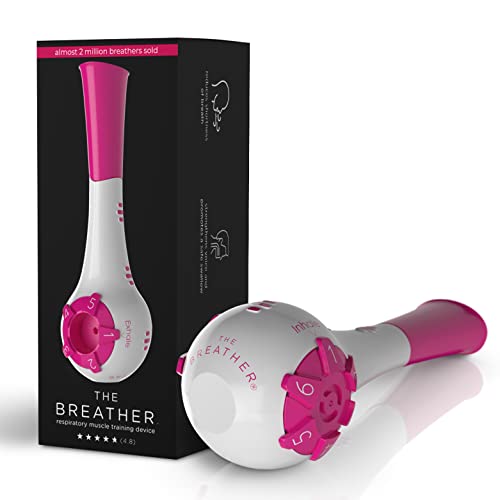
The Breather is a combined respiratory muscle trainer: it resists both halves of the breath through two independent dials. That separation matters during recovery, because inhaling and exhaling rarely regain strength at the same pace. You can keep one direction gentle while challenging the other, without changing devices. This pink version pairs with a guided coaching app that walks through short sessions.
In practice, the routine is brief: sit upright, seal your lips around the mouthpiece, and breathe against the set resistance for a few minutes. Beginners can start at the easiest settings and progress in small steps. The mouthpiece separates from the body so both parts can be washed and left to dry. For someone rebuilding strength after inactivity, this balance of guidance, adjustability, and simple upkeep makes The Breather the most approachable starting point here.
Specs
- Training type: Combined inspiratory and expiratory resistance trainer
- Resistance settings: 6 inspiratory settings and 5 expiratory settings, independently adjustable
- Dimensions: 129 x 43 x 46 mm body
- Weight: 1.6 oz, handheld single-user design
- Registration: FDA-registered Class 1 device, registration number 1058052
- Guidance: Free Breather Coach app for iPhone and Android with training plans
- Cleaning: Mouthpiece separates from body; wash in warm water with mild soap and air dry
POWERbreathe Plus Medium Resistance
The POWERbreathe Plus trains only the in-breath, with a precisely calibrated spring. The valve stays shut until your effort reaches the set threshold, then opens. That pressure-threshold design means every repetition demands the same effort, making progress easy to judge. This blue model carries the medium resistance spring, aimed at people who are already moderately active.
The standard routine is simple: thirty strong, fast breaths in, twice a day. As the weeks pass, you turn the adjustment cap to step the load up. The box typically includes a nose clip, which helps direct all the work through the mouthpiece. Because the medium spring starts at a meaningful load, anyone in very early recovery should check whether the lighter model in the range would be a kinder first step.
Specs
- Training type: Inspiratory muscle trainer with spring-loaded pressure-threshold valve
- Resistance range: Approximately 23 to 186 cmH2O on the medium model
- Resistance settings: 11 adjustable load settings with a level indicator
- Routine: 30 breaths, twice per day, per maker guidance
- Model code: PB2002, blue medium resistance version
- Included items: Device, mouthpiece, nose clip, storage pouch, and user manual
- Power: Fully mechanical, no batteries or charging required
Expand-A-Lung Breathing Fitness Trainer
Expand-A-Lung is the minimalist of this group: a short, pocket-sized trainer, made in the USA since 2004, that creates resistance in both directions through a single adjustable valve. Turning the cap at one end narrows or widens the airway, so the same simple control governs how hard you work breathing in and breathing out. There are no electronics, no app, and almost nothing to assemble, which suits people who want a device they can keep on a side table and use without setup.
The mouthpiece is medical-grade silicone, and the whole unit rinses clean under the tap. Start with the valve fully open and add resistance gradually, in short sets of controlled breaths. One control cannot fine-tune each direction separately the way the dual-dial Breather allows, and there is no volume readout. In exchange, you get the smallest, simplest trainer here, with a long production history and a five-year warranty on parts and labour.
Specs
- Training type: Bidirectional inspiratory and expiratory resistance trainer
- Resistance control: Single adjustable valve, turned to increase or decrease airflow resistance
- Mouthpiece: Medical-grade silicone mouthpiece
- Length: Approximately 4 inches, pocket-sized body
- Origin: Made in the USA, in production since 2004
- Warranty: 5-year warranty on parts and labour stated by the maker
- Cleaning: Rinse the entire unit with dish soap and water, drip dry mouthpiece down
Teleflex Hudson RCI Voldyne 5000 Volumetric Exerciser
The Voldyne 5000 is the incentive spirometer in this lineup, and it works on encouragement rather than resistance. You breathe in slowly through the mouthpiece and watch the piston rise inside the large clear chamber toward the marker you set. The chamber measures up to 5,000 mL, which accommodates the larger inspired volumes of taller adults, and graduations on both sides let a helper or family member read your result from across the bed or chair.
A small flow window labelled with good, better, and best zones coaches your technique, rewarding a slow, steady inhalation instead of a fast gasp. The compact body has a built-in handle, and the tubing end parks in a notch on top between sessions. If your discharge paperwork included a target volume and hourly deep-breathing instructions, this is the style of device those instructions describe, and its feedback is the clearest here.
Specs
- Training type: Volumetric incentive spirometer for sustained maximal inspiration
- Volume capacity: Up to 5,000 mL with graduations on both sides of the chamber
- Feedback: Piston rise plus good, better, and best flow window
- Design: Compact ergonomic body with built-in handle
- Mouthpiece: Adult mouthpiece with particulate filter screen
- Use: Single-patient use, no batteries or calibration required
- Storage: Tubing end seats in a notch at the top of the unit between sessions
Bas Rutten O2Trainer

The Bas Rutten O2Trainer takes a different route to loading the in-breath. Instead of a spring or dial, it restricts airflow through interchangeable intake caps: you fit a cap with a wide opening to start gently, then swap in caps with smaller openings as your inspiratory muscles strengthen. Breathing out passes freely, so all the work lands on the inhale. Former mixed martial arts champion Bas Rutten developed it after his own struggles with asthma.
The routine is short: around thirty controlled breaths a day, at rest or paired with light activity, progressing to a smaller cap when the current one feels manageable. The trainer travels in a pocket, needs no power, and rinses clean after use. Because the hardest caps are demanding, anyone in early recovery should begin with the widest openings and check with their care team before pushing toward the smaller ones.
Specs
- Training type: Inspiratory muscle trainer with interchangeable intake caps
- Resistance settings: 16 interchangeable caps with progressively smaller intake openings
- Resistance direction: In-breath loaded, out-breath passes without resistance
- Model code: 900-02T-Blue, blue version
- Routine: Around 30 controlled breaths per day, per maker guidance
- Power: Fully mechanical, no batteries or charging required
- Cleaning: Rinse the mouthpiece and caps clean and allow to dry
Comparison Summary
These five devices divide neatly by training style. For combined in-and-out resistance with the gentlest learning curve, The Breather offers two independent dials and app guidance, while Expand-A-Lung covers both directions with one simple valve in the smallest body here. For focused inspiratory strength with a repeatable threshold load, the POWERbreathe Plus Medium suits more active users, and the Bas Rutten O2Trainer loads the in-breath through interchangeable caps in a pocket-sized format built for training on the move. For guided deep-breathing practice with a visible volume target, the Voldyne 5000 stands alone as a true incentive spirometer.
On feedback, the spirometer wins outright, since its piston turns every breath into a number. The trainers answer with numbered settings: progression shows up as a harder setting held with good form. On cleaning, all five wash with warm water and mild soap, with Expand-A-Lung quickest to rinse. The POWERbreathe medium spring reaches the highest loads, while The Breather and the O2Trainer can both start gently at their easiest settings, which often matters more in the first weeks at home.
Frequently Asked Questions
How often should I use a breathing exerciser during recovery?
Follow the schedule your own clinician set first, because it reflects your condition and surgery or illness history. In general terms, incentive spirometer routines are usually built around sets of slow deep breaths repeated regularly through the waking day, while resistance trainers are usually used in one or two short sessions daily. Consistency across days matters more than one long, exhausting session, so stop if you feel dizzy and build up gradually.
What is the difference between an incentive spirometer and a muscle trainer?
An incentive spirometer encourages slow, deep inhalation and shows you the volume of air you moved with a rising piston or ball, but it adds little resistance. A muscle trainer does the opposite: it makes the breathing muscles work against a set load, through a spring, dial, or valve, without measuring volume. Many recovery plans use the spirometer style early on for deep-breathing practice, then add resistance training as strength and endurance return.
How do I clean a breathing exerciser at home?
Separate the mouthpiece from the body where the design allows, wash the parts in warm water with a few drops of mild dish soap, rinse thoroughly so no residue remains, and let everything air dry completely before the next session. Never share a device between people, and replace a spirometer or mouthpiece that becomes cracked, cloudy, or difficult to clean. Check the leaflet with your specific model, since a few parts on some trainers should not be immersed.
When should I increase the resistance setting?
Increase the load only when you can complete your full session at the current setting with good form and without unusual breathlessness, and you have held that standard for several sessions in a row. Move up by the smallest step available, and expect the first day at a new level to feel noticeably harder. If a new setting breaks your technique or leaves you light-headed, return to the previous level and try again after a few more days, or ask your therapist for guidance.
Conclusion
Rebuilding lung strength at home is slow, steady work, and the best exerciser is the one matched to your stage of recovery and used every day. Choose the Voldyne 5000 for deep breaths against a visible volume target, The Breather for guided two-way resistance, Expand-A-Lung for the simplest pocket-sized trainer, the POWERbreathe Plus Medium for demanding inspiratory work, or the Bas Rutten O2Trainer for cap-based inspiratory training you can do anywhere. Set a level you can handle with good form, log your sessions, clean the device after use, and let small weekly gains carry you back to comfortable breathing.
More from Amazon
Programs that pair well with the guide above. Offers and eligibility are set by Amazon and may change.
Collect the home and kitchen items you want in one registry that guests can shop from.
Create a wedding registrySet up recurring deliveries of everyday items on eligible products. Terms and savings are set by Amazon.
Explore Subscribe & SaveFree shipping on eligible items, Prime Video and more. Eligible new members can start with a free trial.
Start a Prime free trialAudiobooks and podcasts to listen to on the go. Eligible new members can start with a free trial.
Try Audible freeAs an Amazon Associate we earn from qualifying purchases.
Write Your Review
No reviews yet. Be the first to share your experience!