

Key takeaways
- Rinse the vessel, lid, dip tube, faucet, and beverage line promptly after emptying.
- Wash with the recommended mild detergent and warm water; avoid abrasive pads on polished surfaces.
- Disassemble removable seals and fittings so trapped coffee does not remain behind them.
- Sanitize according to the manufacturer’s instructions, then allow components to dry fully.
- Inspect O-rings for flattening, cracks, or persistent leaks before the next batch.
- Never leave a pressurized keg unattended when a leak is suspected.
The best nitro cold brew makers depend on how much coffee you serve: choose a countertop nitrogen infuser for occasional single-glass pours, or a small keg system for repeatable texture, multiple servings, and longer storage.
Our top picks


As an Amazon Associate we earn from qualifying purchases at no extra cost to you. Ratings are shown as listed on Amazon.
Quick picks by situation
| Situation | Best design | Why it fits | Main compromise |
|---|---|---|---|
| One to four glasses at a time | Countertop infuser | Lower commitment, fast setup, little refrigerator space | Each batch may need to be charged separately |
| Daily nitro coffee for one or two people | 64-ounce keg | Good balance of capacity, consistency, and footprint | Requires cold storage and cleaning after each batch |
| Parties or several servings per day | 128-ounce keg | Fewer refills and more stable serving pressure | Heavier, taller, and more expensive to chill |
| Small kitchen or shared refrigerator | Handheld or compact countertop system | Can be stored in a cupboard and used on demand | Foam and texture depend more on technique |
| Lowest ongoing cost | Keg with a larger nitrogen cylinder | Bulk nitrogen generally costs less per serving than small cartridges | Needs a regulator, compatible fittings, and safe cylinder storage |
Countertop makers versus keg systems
Countertop nitrogen infusers
A countertop maker usually combines chilled coffee with nitrogen in a bottle, canister, or serving chamber. Some use food-grade nitrogen cartridges; others connect to a larger nitrogen source. The advantage is convenience: you can make a modest quantity without dedicating a refrigerator shelf to a keg.
These machines are a sensible choice if you drink nitro coffee only a few times per week or prefer changing flavors frequently. They are also easier to justify for a first purchase. However, their working capacity is commonly around 0.5 to 2 liters, and the final pour can vary if the coffee is not cold enough, the cartridge is nearly empty, or the device is shaken inconsistently.
Keg-based makers
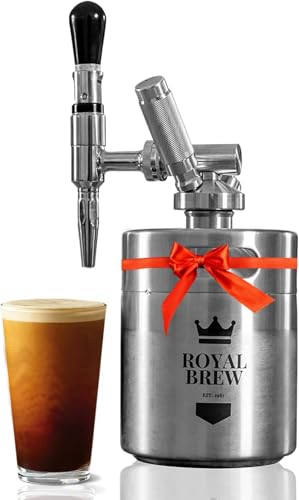
A keg system stores cold brew in a pressurized stainless-steel container and dispenses it through a faucet. Common home sizes are approximately 64 ounces and 128 ounces. GrowlerWerks uKeg Nitro models and home nitro keg kits from brands such as Royal Brew illustrate this format, although fittings, cartridge compatibility, and included accessories differ by model.
Kegs usually win for texture consistency. Once the coffee is properly chilled and the pressure is stable, successive pours are more alike than pours made in a small handheld chamber. The trade-off is ownership complexity: you must chill the whole batch, clean beverage lines, check seals, and budget for nitrogen cartridges or a cylinder.
Specifications that matter more than the product name
| Design | Typical capacity | Typical footprint | Pressure source | Practical serving output | Best use |
|---|---|---|---|---|---|
| Handheld infuser | 16–32 fl oz | About 3–5 in wide, 8–12 in tall | One small nitrogen cartridge | 2–4 glasses | Occasional use |
| Countertop bottle or chamber | 0.5–2 liters | About 5–8 in wide, 10–16 in tall | Cartridge or external nitrogen | 4–8 glasses | Small households |
| 64-ounce keg | 1.9 liters | About 6–8 in wide, 10–15 in tall | Cartridge or nitrogen cylinder | 6–8 servings | Daily personal use |
| 128-ounce keg | 3.8 liters | About 7–10 in wide, 14–20 in tall | Cartridge or nitrogen cylinder | 12–16 servings | Families and entertaining |
These are useful planning ranges rather than universal specifications. A listed capacity is not always the amount you should fill: leave the headspace required by the manufacturer so nitrogen can mix and the keg can dispense correctly.
Nitrogen, cartridges, and the real cost per serving
Small nitrogen cartridges are convenient but can become the most expensive part of frequent use. Depending on cartridge size, pressure, equipment efficiency, and waste during purging, a home system may use roughly one cartridge for a small countertop batch or one to several cartridges for a larger keg cycle. Read the maker’s instructions before substituting cartridge sizes or using carbon dioxide cartridges.
For a simple comparison, assume a 64-ounce keg produces eight 8-ounce servings. If a nitrogen charge costs $2 to $4, gas contributes approximately $0.25 to $0.50 per serving. Add coffee concentrate, water, and any sweetener separately. A larger nitrogen cylinder usually reduces the gas cost per serving, but the regulator and cylinder deposit or rental may outweigh the savings for occasional users.
Do not choose a system solely because its cartridges are inexpensive. Check whether cartridges are easy to source, whether the connection is proprietary, and whether the device requires a separate regulator. A system that uses a common food-grade nitrogen connection may cost more initially but offer better long-term flexibility.
Chilling is not optional
Nitro coffee pours best when the cold brew and serving hardware are thoroughly chilled. Warm liquid holds less dissolved gas and tends to produce a thinner, less stable cascade. Refrigerate the brewed coffee before charging it, and chill a keg for several hours rather than filling it with room-temperature coffee immediately before serving.
A practical workflow is:
- Filter the cold brew carefully to remove fine grounds that can clog the dip tube or faucet.
- Chill the coffee to refrigerator temperature before transferring it.
- Fill only to the manufacturer’s maximum line, leaving the specified headspace.
- Attach the nitrogen source and charge at the recommended pressure.
- Gently agitate or roll the container only as directed; excessive shaking can create foam and waste gas.
- Allow the coffee to rest cold before the first pour if the instructions call for a conditioning period.
- Pour through a clean faucet or nozzle into a cold glass.
For a keg, the first pour may contain excess foam or sediment. Pour it slowly, confirm that the coffee line is fully connected, and adjust pressure in small increments rather than repeatedly opening and closing the system.
Cleaning and durability: what wears first
The stainless-steel vessel is usually the durable part. Gaskets, O-rings, faucet seals, beverage tubing, and cartridge puncture components experience more wear. Coffee oils can also leave a film that affects flavor and interferes with seals if the system is only rinsed.
- Rinse the vessel, lid, dip tube, faucet, and beverage line promptly after emptying.
- Wash with the recommended mild detergent and warm water; avoid abrasive pads on polished surfaces.
- Disassemble removable seals and fittings so trapped coffee does not remain behind them.
- Sanitize according to the manufacturer’s instructions, then allow components to dry fully.
- Inspect O-rings for flattening, cracks, or persistent leaks before the next batch.
- Never leave a pressurized keg unattended when a leak is suspected.
A common mistake is cleaning only the reservoir while neglecting the faucet and narrow beverage tube. That can produce sour flavors, restricted flow, and inconsistent foam even when the nitrogen charge is correct. Another is using carbon dioxide in equipment designed for nitrogen: carbon dioxide produces a sharper, more sparkling drink and can change the coffee’s flavor and pressure behavior.
How to choose the best nitro cold brew maker for you
Choose a countertop design if…
You want the smallest commitment, make fewer than four servings at a time, and do not want a pressurized vessel occupying refrigerator space. Prioritize a removable, dishwasher-safe beverage path, clear fill markings, readily available cartridges, and a chamber that can be chilled easily.
Choose a 64-ounce keg if…
You drink nitro coffee most days but have limited space. It is large enough to make a useful batch without creating a week-long storage problem. Look for stainless-steel construction, replaceable seals, a standard-style faucet, and a pressure gauge or clear pressure guidance.
Choose a 128-ounce keg if…
You serve several people or want fewer brewing sessions. Measure the refrigerator shelf first, including the height needed to attach the lid and gas line. A large keg is poor value if it cannot remain cold or if you regularly discard unfinished coffee.
Bottom line
The best nitro cold brew makers are not necessarily the most elaborate. A countertop infuser is the better fit for occasional, small-batch use and limited space. A 64-ounce keg is the strongest all-round choice for a regular drinker, while a 128-ounce keg earns its size when several people are served. Whichever format you choose, prioritize reliable chilling, compatible nitrogen supplies, replaceable seals, and a beverage path that can be fully disassembled and cleaned.

Write Your Review
No reviews yet. Be the first to share your experience!