

Our Short List of 3

- Frame type: Freestanding stand-alone rail, no seat-bolt connection
- Material: Lightweight, corrosion-resistant aluminum frame
- Weight capacity: Supports up to 300 pounds
- Overall size: 26.5 inches wide at the base, 19 inches deep, 25.5 inches high

- Frame type: Bolt-on toilet safety rail using existing seat mounting points
- Model: Drive Medical RTL12087
- Width between arms: Adjustable from about 16.5 inches to 19.5 inches
- Arm height: About 26 inches

- Frame type: Toilet-mounted safety rail with adjustable bracket and floor legs
- Model: Medline MDS86100RF
- Height adjustment: Armrests adjustable from 27.5 inches to 31.5 inches
- Overall width: Adjustable from about 19 inches to 22 inches
All 5 Picks at a Glance
| Product | Specs | Action |
|---|---|---|
| 1. Vive Toilet Safety Rail — Freestanding Frame With Padded Arms |
| Check price on Amazon |
| 2. Drive Medical RTL12087 Toilet Safety Rail |
| Check price on Amazon |
| 3. Medline Toilet Safety Rail |
| Check price on Amazon |
 4. OasisSpace Stand Alone Toilet Safety Rail |
| Check price on Amazon |
 5. RMS Toilet Safety Frame & Rail |
| Check price on Amazon |
Key takeaways
- Compare toilet safety rails on frame strength, width adjustment, grip comfort and installation to add steady support for safer sitting and standing daily.
As an Amazon Associate we earn from qualifying purchases.
Disclosure: This article contains affiliate links. If you buy through these links, we may earn a commission at no extra cost to you.
Introduction
Sitting down on a toilet and getting back up again looks simple until knees, hips, balance, or a recent procedure make it anything but simple. The seat is low, the floor can be smooth, and there is often nothing solid at the right height to hold on either side. A toilet safety rail solves that problem: two steady armrests beside the bowl, at a height you can push down through with both hands, so the movement down and up stays controlled instead of rushed.
This guide is only about toilet safety rails and frames that surround or mount beside a toilet. It is not about raised seats, and none of the picks below changes the height of your seat. Each pick was chosen for frame strength, sensible adjustment, comfortable grips, and an installation method that suits real home bathrooms.
The five picks cover the main approaches you will meet. Some bolt on using the existing seat bolts and keep a compact footprint. Others stand freely around the bowl, which suits renters and anyone who wants to move the frame aside for cleaning. One folds flat for storage or travel.
How to Choose a Toilet Safety Rail
Frame strength and weight capacity
Look first at the stated weight capacity and at how the frame carries load. Bolt-on rails transfer load into the bowl and floor through short front legs, so they can feel very solid in a small space. Freestanding frames carry load through floor contact points on both sides, so check that the base is wide and the feet are capped. Aluminum is light and resists corrosion, while steel feels heavier and more planted. Stay well within the stated limit and push down through both arms evenly.
Width and height adjustment
Width between the arms decides comfort as much as strength does. Too narrow and hips feel squeezed and hands sit too close to the body to push effectively. Too wide and shorter arms cannot reach both sides with good leverage. Adjustable models let you set the spacing for the main user, then change it for someone else. Height matters too: armrests set too low force a deep bend at the knees, while armrests set too high shrug the shoulders. The best fit lets the forearms rest fairly level, with elbows slightly bent, as the user begins to rise.
Grip comfort and armrest shape
Padded foam and textured armrests are kinder on palms and wrists than bare metal, and a wider armrest spreads pressure better than a thin round tube. Check whether the padding is wipeable, because cleaning is frequent. Arms that extend far enough forward give a useful hand position while lowering and rising.
Installation method and toilet fit
Bolt-on rails share the two bolts that hold the toilet seat. They need a standard bolted seat, clearance behind the seat hinges, and usually a fairly flat tank face. They will not suit many smart toilets, bidet seats with hidden fixings, quick-release seats, or curved tanks, so measure that rear clearance before ordering. Freestanding rails avoid the seat bolts entirely, but need floor space on both sides and a level floor. Whichever style you pick, test it first: push down firmly on each arm and watch for rocking or bolt movement.
1. Vive Toilet Safety Rail — Freestanding Frame With Padded Arms
- Frame type: Freestanding stand-alone rail, no seat-bolt connection
- Material: Lightweight, corrosion-resistant aluminum frame
- Weight capacity: Supports up to 300 pounds
- Overall size: 26.5 inches wide at the base, 19 inches deep, 25.5 inches high
The freestanding Vive rail is the simplest idea in this group: a complete frame that stands on the floor around the toilet, with no connection to the seat bolts at all. That makes it a strong choice for renters and for anyone who may want to move the frame between bathrooms. The base is wide, the lower rails run front to back for resistance to tipping, and assembly needs no tools.
The padded handles are the feature people notice most. The foam gives a softer, higher-friction hold than bare tubing, which helps when hands are damp or grip strength is limited. The aluminum build keeps the frame light enough to slide aside for cleaning, and a removable storage holder keeps essentials within reach. It surrounds most standard and elongated toilets, and because nothing attaches to the bowl, bidet and quick-release seats cause fewer headaches than with bolt-on rails. You do need clear floor on both sides. If your bathroom has the space, this is the most flexible pick here.
2. Drive Medical RTL12087 Toilet Safety Rail
- Frame type: Bolt-on toilet safety rail using existing seat mounting points
- Model: Drive Medical RTL12087
- Width between arms: Adjustable from about 16.5 inches to 19.5 inches
- Arm height: About 26 inches
Drive Medical is a long-established home medical brand, and the RTL12087 is its compact bolt-on answer for small bathrooms. Instead of standing on legs around the bowl, this rail attaches at the rear using the existing seat mounting points, presenting two padded arms close beside the seat. With no freestanding base to step around, it leaves floor space clear, which matters where the toilet sits tight against a wall or vanity.
A bolt-on design depends on sound seat bolts and a compatible seat, so check the rear mounting area first and keep the fixings snug. Anyone who needs a wide stance should compare the range against the wider freestanding options below. For a neat rail in a compact room, this model covers the basics with little fuss.
The arms adjust in width, the armrests are padded, and the white finish blends with most fixtures. Because the rail is fixed to the toilet, it can feel especially secure on uneven flooring.
3. Medline Toilet Safety Rail
- Frame type: Toilet-mounted safety rail with adjustable bracket and floor legs
- Model: Medline MDS86100RF
- Height adjustment: Armrests adjustable from 27.5 inches to 31.5 inches
- Overall width: Adjustable from about 19 inches to 22 inches
Medline supplies hospitals and care settings at large scale, and its home rail follows the same practical pattern: an aluminum frame that mounts securely at the toilet, with height-adjustable armrests and legs that reach the floor for support. That combination gives it a composed feel, and the adjustment range is among the most useful here for taller users.
The stated capacity is lower than the other picks here, so this rail suits users who stay comfortably within that limit and mainly need balance and guided support. The arms are for assistance while sitting and standing, not for bearing full body weight in a sideways transfer. Used as intended, it is a tidy, clinically minded rail.
Height and overall width both adjust, so one frame can be tuned as recovery progresses or shared between users. The waterfall-style armrests are comfortable under the forearm, with foam padding that wipes clean.
4. OasisSpace Stand Alone Toilet Safety Rail
- Frame type: Stand-alone freestanding toilet safety rail, no seat-bolt connection
- Weight capacity: Supports up to 300 pounds
- Product weight: About 7.48 pounds
- Width: Adjustable arm spacing to fit different toilets and users
The OasisSpace stand-alone rail suits households that want a heavier-duty freestanding frame with room to adjust the fit. Like the Vive pick, it stands around the bowl without using the seat bolts, so installation is simply assembling the frame and positioning it, with no tools and no changes to the toilet itself.
Because it is freestanding, stability depends on a level floor and on all feet sitting firmly, so position it squarely and test for rocking before first use. Keep the area free of loose mats. For users who want a substantial, movable frame with no fixings at all, this is a practical middle ground.
Width adjustment is valuable in a shared bathroom: set the arms closer for a smaller person, then widen them for a larger user. The stand-alone layout can also be lifted away for cleaning.
5. RMS Toilet Safety Frame & Rail
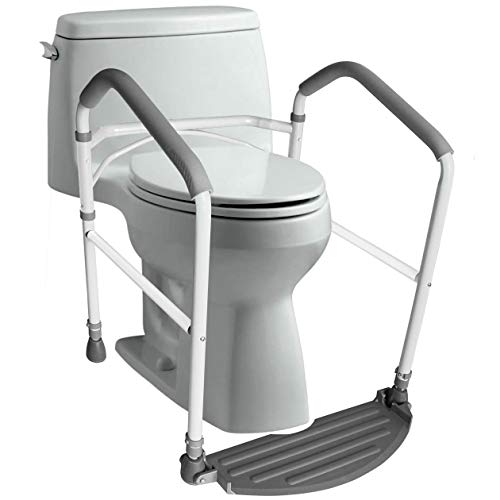
- Frame type: Freestanding folding toilet safety frame and rail
- Height adjustment: Adjustable from 28 inches to 36 inches, floor to top of arm
- Width between arms: 20 inches
- Weight capacity: Supports up to 300 pounds
RMS, short for Royal Medical Solutions, takes a different approach: a freestanding frame that folds flat. For many households that single feature decides the purchase. The frame can be set up for everyday use, then folded and set aside when visitors come, when the bathroom is cleaned, or when support is only needed for a recovery period. It also travels well, because there is nothing to unbolt.
No assembly is required beyond unfolding and setting the height. As the maker notes, the user does need enough arm strength to push against the rails to rise, which is true of every rail here. If storage, portability, or a taller arm height is your priority, this is the natural pick.
The height range runs well above the other picks here, helping taller users. A locking foot rest at the base adds stability, with the user’s own footing helping to hold the frame in place.
Comparison Summary
All five rails do the same core job — two armrests beside the toilet — and none changes your seat height. The differences are mounting, adjustment, and how easily the frame moves.
For the least installation effort, choose a freestanding frame. The Vive offers a wide base with padded arms and a side holder, while the OasisSpace adds width adjustment in a heavier-duty build. Both need floor space on each side.
For the smallest footprint, choose a bolt-on rail. The Drive Medical RTL12087 keeps arms close beside the seat and leaves the floor clear, and the Medline adds a wider height range, though with a lower capacity. Both need a compatible bolted seat.
For storage and travel, the RMS frame stands apart: it folds flat, needs no assembly, and offers the tallest height range here. Its trade-off is a fixed width between the arms. Measure your bathroom first, and the right choice usually becomes obvious.
Frequently Asked Questions
Will a toilet safety rail fit an elongated toilet?
Most rails here work with both standard and elongated toilets. Freestanding frames such as the Vive, OasisSpace, and RMS surround the bowl, so bowl length rarely matters if the frame can sit squarely. Bolt-on rails such as the Drive Medical and Medline depend more on the seat bolt area, so check rear clearance and seat type before ordering.
Do I need tools or drilling to install one of these rails?
No drilling is needed for any pick here. Freestanding and folding frames assemble or unfold without tools. Bolt-on rails use the existing seat bolts, so fitting means removing the seat, placing the bracket, and refitting the seat. No pick requires fixings into walls or floors.
How do I set the right arm height and width?
Set the height so the user can place both palms flat on the armrests with elbows slightly bent while seated, without shrugging or bending deeply. Set the width, where it adjusts, so the hands sit roughly under the shoulders and the hips clear the arms. Test the full movement before settling on a setting.
Can a safety rail be used after hip or knee surgery?
Many people use a rail during recovery because it lets both arms share the work of lowering and rising, reducing the effort demanded from healing legs. Surgical precautions vary, though, and some procedures limit joint movement or weight bearing. Follow your surgical and therapy team’s guidance, and ask them to confirm that a rail fits your recovery plan.
Conclusion
A good toilet safety rail does not call attention to itself. It is simply there, at the right height and width, every time you need it. The five rails above cover the main ways to get that support at home: freestanding frames from Vive and OasisSpace, bolt-on rails from Drive Medical and Medline, and a folding RMS frame.
Start with fit. Measure the space around your toilet, check whether your seat can accept a bolt-on bracket, and consider the load involved. Fitted well and checked regularly, a safety rail turns a risky small movement into a calm, steady routine.
More from Amazon
Programs that pair well with the guide above. Offers and eligibility are set by Amazon and may change.
Collect the home and kitchen items you want in one registry that guests can shop from.
Create a wedding registrySet up recurring deliveries of everyday items on eligible products. Terms and savings are set by Amazon.
Explore Subscribe & SaveFree shipping on eligible items, Prime Video and more. Eligible new members can start with a free trial.
Start a Prime free trialAudiobooks and podcasts to listen to on the go. Eligible new members can start with a free trial.
Try Audible freeAs an Amazon Associate we earn from qualifying purchases.


Write Your Review
No reviews yet. Be the first to share your experience!