

Key takeaways
- Choose a corded kneading wrap for dependable home sessions, a rechargeable wrap for mobility, and a vibration collar for lighter, wider coverage. Prioritize independently controlled heat, at least two intensity levels, automatic shutoff, washable materials, and adjustment range. The best neck and shoulder massagers are…
Best Neck and Shoulder Massagers for Targeted Relief
The best neck and shoulder massager is the one that matches your preferred pressure, covers the areas you actually want to reach, and fits your body without forcing your shoulders forward. For most people, a rechargeable kneading wrap is the most flexible choice; a corded shiatsu wrap is better for frequent home use, while a compact vibration device suits lighter pressure and travel.
Quick comparison: which type fits your routine?
| Massager type | Typical massage zones | Pressure feel | Heat | Power and weight | Best for |
|---|---|---|---|---|---|
| U-shaped kneading wrap | Upper trapezius, sides of neck, base of skull | Medium to strong; controlled by hand straps | About 38–45°C (100–113°F) | Usually corded; 1.2–1.8 kg | Deep, repeatable home sessions |
| Rechargeable kneading wrap | Neck, shoulders, upper back; sometimes arms and calves | Medium to strong | Often 40–45°C | Typically 1–3 hours per charge; 1.0–1.6 kg | People who want cordless movement |
| Vibration neck wrap | Broad contact over neck and shoulder tops | Light to medium, with less pinpoint pressure | Commonly optional, around 38–42°C | USB or battery powered; 0.4–1.0 kg | Beginners, desk use, and sensitive users |
| Handheld percussion device | Targeted shoulder, upper-back, and surrounding muscles | Adjustable from gentle to very firm | Usually none | Rechargeable; 0.6–1.2 kg | Precise targeting, provided you can reach the area |
| Manual trigger-point tool | Small areas around the shoulders and upper back | Self-controlled and potentially intense | None | No battery; commonly under 0.5 kg | Low-cost occasional use and travel |
These are representative ranges rather than specifications for every model. Actual heat, runtime, dimensions, and pressure vary by manufacturer. Recognizable examples in this category include products from HoMedics, RENPHO, Nekteck, Zyllion, and similar established massage-equipment brands, but the design details matter more than the logo.
Our top picks


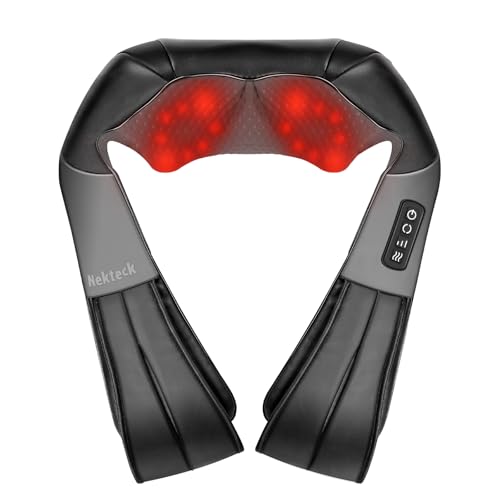
As an Amazon Associate we earn from qualifying purchases at no extra cost to you. Ratings are shown as listed on Amazon.
Best choices by situation
| Your situation | Most suitable design | Why | What to check before buying |
|---|---|---|---|
| Budget under about $50 | Basic vibration wrap or manual tool | Lower cost and simpler construction | Return policy, washable cover, automatic shutoff |
| Frequent use at home | Corded kneading wrap | Consistent power without charging delays | Adapter length, heat control, replacement-cover availability |
| Travel or use in several rooms | Rechargeable wrap | No outlet required during a session | Battery capacity, charging time, total weight |
| New to massage devices | Vibration model with low and high settings | More forgiving than fixed, deep kneading nodes | Low-intensity mode and easy-to-reach controls |
| Broad shoulders or a thick neck | Wide wrap with adjustable hand straps | Allows you to position the massage heads instead of stretching the fabric | Head spacing, strap length, and usable wrap width |
| Small frame or narrow shoulders | Compact wrap or flexible vibration collar | Reduces the chance that nodes sit too far outward | Minimum adjustment range and head placement |
Compare the massage zones before comparing motor strength
A wrap with rotating nodes is usually strongest at the upper trapezius muscles, the sloping muscles between the neck and shoulders. Its lower edge may also reach the upper back, but the exact coverage depends on your torso length and how tightly you hold the straps. Some models include rotating heads that reverse direction; this can prevent one-sided wear and lets you choose the direction that feels more comfortable.
Vibration wraps cover a broader surface but usually create less concentrated pressure. They can be a better match when you want stimulation across both shoulders while working at a desk. Handheld percussion devices offer the most precise targeting, but they require enough reach and control to avoid pressing directly on the front or sides of the neck.
Do not assume that more massage heads means better coverage. Four large nodes can feel more focused than six small ones, while widely spaced heads may miss the muscles on a narrow frame. Look for a product diagram showing the head-to-head distance, not only the number of heads.
Heat and pressure: the settings that matter
Heat should be independently switchable from massage intensity. That allows you to use gentle kneading without heat, or heat without a high-pressure cycle. A practical minimum is two pressure or speed levels, although three or more levels make it easier to accommodate different sessions.
Fixed kneading nodes can feel firm because the device presses against the body as well as rotating. Hand straps are useful: pulling lightly increases contact, while loosening the straps reduces pressure. This is especially important for people with a smaller neck or less muscle padding. A model that only feels effective when pulled tightly may be poorly fitted for your body.
Heat is normally mild rather than equivalent to a heating pad. Check that the product has automatic shutoff, preferably after 10–15 minutes. Never cover the ventilation area or fall asleep while using a heated device. If you have reduced heat sensation, circulation concerns, or a condition affected by heat, ask a qualified health professional before using that feature.
Corded versus cordless designs
Corded massagers generally provide the most consistent output and are sensible for a fixed chair, bedroom, or home office. They also avoid battery aging. Their disadvantages are an outlet requirement and a cable that can pull on the unit if the adapter is positioned poorly. Check whether the included adapter is designed for your country’s voltage rather than relying on a plug-shape adapter alone.
Cordless models are easier to move and can be used away from a desk. Their published runtime often assumes low intensity and no heat. A useful way to estimate practical runtime is:
Estimated sessions = battery runtime ÷ session length. For example, a model rated for 120 minutes may provide about eight 15-minute sessions under favorable conditions. If heat and high intensity reduce runtime by 25%, the same battery may deliver closer to six sessions. That difference matters if you use the massager daily and do not want to recharge it every few days.
For regular use, look for USB-C charging, a battery indicator, and a charge time of roughly two to four hours. Avoid storing a lithium battery completely empty for long periods. Recharge it before storage and keep the unit away from excessive heat.
Fit: a simple positioning test
- Place the lower edge on the upper back rather than directly across the cervical spine.
- Center the rotating or vibrating zones over the muscle on each side of the neck.
- Let the shoulders remain relaxed. Do not shrug to hold the device in place.
- Start at the lowest setting for five minutes.
- Move the device slightly up, down, or outward if one point receives all the pressure.
A good fit feels balanced on both sides and does not require constant pulling. If the heads sit on the bony spine, front of the throat, or the top edge of the shoulder joint, stop and reposition the device. For a larger neck or broader shoulders, prioritize generous adjustment and a wider contact area over maximum motor power. For a smaller frame, choose a compact design with shorter head spacing.
Ownership details that affect value
The first parts to wear are commonly the fabric cover, hand straps, charging cable, and rotating-head mechanism. Sweat, hair products, and skin oils can make the cover unpleasant even when the motor still works. Choose a removable, machine-washable cover where possible. If the cover is not removable, unplug the unit and wipe the surface with a lightly damp cloth, then allow it to dry fully. Do not immerse the motor housing.
Do not use a kneading wrap for longer than its timed cycle unless the instructions specifically permit it. Longer sessions can increase soreness and heat exposure without improving the experience. Keep the cable away from the moving mechanism, do not pull the device by its cord, and store it flat enough that the nodes are not compressed.
General market pricing is approximately $25–$60 for simple vibration or manual options, $45–$120 for mainstream kneading wraps, and $100–$200 or more for premium cordless or multi-zone designs. A $90 corded massager used three times per week for one year costs about $0.58 per session before electricity, calculated as $90 divided by 156 sessions. That can be better value than paying more for cordless convenience you rarely use.
Safety and when to get advice
These devices are for general comfort and relaxation, not diagnosis or treatment. Avoid placing pressure on the front of the neck, directly over the spine, open skin, or areas with unexplained swelling or numbness. Stop if you experience sharp pain, dizziness, unusual weakness, persistent tingling, or skin irritation. If neck or shoulder discomfort is severe, follows an injury, keeps returning, or is accompanied by neurological symptoms, seek advice from a qualified healthcare professional rather than increasing massage intensity.
Bottom line
Choose a corded kneading wrap for dependable home sessions, a rechargeable wrap for mobility, and a vibration collar for lighter, wider coverage. Prioritize independently controlled heat, at least two intensity levels, automatic shutoff, washable materials, and adjustment range. The best neck and shoulder massagers are not necessarily the strongest models; they are the ones whose zones, pressure, power source, and physical dimensions match the way you will actually use them.




Write Your Review
No reviews yet. Be the first to share your experience!