

Key takeaways
- Compare back support belts on brace design, compression, sizing and breathability to ease lower back strain through workdays, lifting and daily chores.
As an Amazon Associate we earn from qualifying purchases.
Disclosure: This article contains affiliate links. If you buy through these links, we may earn a commission at no extra cost to you.
Our top pick: Mueller Adjustable Back Brace. Runner-up: FEATOL Back Brace Support Belt.
Introduction
A long shift on your feet, a morning of lifting boxes, or an afternoon of yard work can all end the same way: a tired, aching lower back. The best back support belts do not fix an injury, and they are not a substitute for medical care, but a well-fitted belt adds steady compression around the lumbar region, reminds you to lift with better form, and spreads effort across your midsection.
Belts that look similar in photos behave very differently in use. Some are simple elastic work belts. Others are structured braces with steel springs, flexible stays, or a shaped lumbar pad. Sizing systems differ too: one brand measures at the navel, another at the widest part of the waist. Breathability matters just as much, because a belt you remove after an hour from heat gives you no support at all.
This guide compares five proven belts for work, lifting, and posture on brace design, compression, sizing, and breathability.
How to Choose a Back Support Belt
Begin with the support structure, because it decides how firm the belt feels. Flexible elastic belts rely on wrap tension alone and suit light duties. Braces with stays or springs add vertical structure that resists rolling and keeps the panel spread across your lower back, helping during lifting and long standing. A lumbar pad concentrates pressure on the curve of the spine; a removable pad is more versatile, since you can take it out for gentler support.
Next, look at how compression is adjusted. Dual straps let you set the base wrap once and then fine-tune the squeeze as your back tires during a long shift.
Sizing deserves real care. Measure exactly where the brand tells you to measure, over light clothing, and compare that number with the printed range rather than guessing from your trouser size. A belt worn too loose slides around, while one worn too tight restricts breathing and bending.
Breathability and profile come next. Mesh panels suit warm workplaces and summer chores, while neoprene holds more warmth for stiff muscles in cold conditions. A low-profile brace fits under a shirt; a taller panel gives more coverage for lifting. Close the straps before washing, air-dry the belt, and wear it for the demanding parts of the day rather than every waking hour.
Mueller Adjustable Back Brace

The Mueller Adjustable Back Brace is the firm, traditional choice in this group, from a sports medicine brand with decades of history in supports. Its defining feature is eight steel springs sewn into the back panel. The panel stays spread across the lumbar region instead of bunching into a narrow band, and compression stays even when you bend, twist, or lift. If lighter elastic belts have felt flimsy, this is the step up in stability.
The wraparound design uses a double layer: position the main belt, then pull the outer straps to dial in the fit, adding support before a lift and easing off afterwards. The wide nine-inch elastic panel covers a generous area of the lower back and abdomen, and mesh sections let air move during long wear. Check the sizing overlap before ordering, and choose by whether you prefer a closer or roomier wrap. This brace suits warehouse work, moving days, and gym lifting where firm support matters more than a slim profile. It is bulkier under thin clothing than the mesh options below, and people sensitive to latex should check the materials list.
Specs
- Support structure: 8 steel springs in the back panel for firm, even compression
- Panel: 9-inch wide elastic wraparound band with double-layer design
- Closure: Adjustable wraparound straps for staged tightening
- Sizing: S/M fits waists 22 to 34 inches; One Size fits waists 28 to 50 inches
- Fabric: Breathable mesh sections with odor-resistant treatment
- Intended uses: Upper and lower back pain, strains, sciatica, and scoliosis support
FEATOL Back Brace Support Belt

The FEATOL Back Brace Support Belt is built around targeted lumbar pressure. Four strong support strips run through the back panel, and an extra lumbar pad sits against the curve of your spine where most people feel strain first. The pad is removable, so you can run the brace firmer for lifting days and softer for driving or desk work. That flexibility makes it a good first brace for people unsure how much support they want.
Construction is a two-part system. The inner belt is elastic neoprene for base compression, while the outer elastic band adds adjustable squeeze on top. This is one of the warmer braces in the group, which many users prefer for stiff muscles. Sizing is unusually thorough: a full ladder through extended sizes, all measured around the navel rather than by trouser size. With the right size, the pad lands in the lumbar curve and the brace supports lifting and long standing shifts without constant readjustment.
Specs
- Support structure: 4 support strips plus a removable extra lumbar pad
- Inner belt: Elastic neoprene wrap for base compression
- Outer closure: Elastic band with hook-and-loop fastener for adjustable tension
- Sizing by navel circumference: S/M 24.4 to 29.8 inches, L/XL 29.8 to 38.6 inches, XXL 38.6 to 51.2 inches, with extended sizes up to 5XL
- Weight and size: About 1 pound; roughly 10 x 9 x 2 inches packaged
- Intended uses: Back pain, sciatica, scoliosis, herniated disc, and lumbar support
BraceUP Stabilizing Lumbar Back Brace (B601)

The BraceUP Stabilizing Lumbar Back Brace, model B601, takes the opposite approach to bulk: a slim, lightweight mesh brace for all-day wear, including under work clothes. Eight flexible support stays across the back panel keep it flat and spread pressure evenly, without the rigid feel of steel springs. Silicone anti-slip elements help it stay seated when you bend and straighten, where thin braces usually creep upward.
Dual adjustable straps are the main control: wrap the brace, fasten the main closure, then pull the two straps forward to set compression, snugger at the top or bottom as your back needs. The breathable mesh body lets air pass far more freely than neoprene, suiting warm warehouses, kitchens, delivery routes, and summer work. At about 270 grams, it is light enough to forget during a shift, and the low profile rarely shows through a shirt. The trade-off is general, even compression rather than a focused lumbar pad, so for concentrated pressure look at the FEATOL or Sparthos instead. Sizing comes in three broad bands; pick the band containing your waist measurement.
Specs
- Model: BraceUP B601 stabilizing lumbar brace
- Support structure: 8 flexible support stays across the back panel
- Closure: Dual adjustable straps with hook-and-loop fastening
- Sizing: S/M fits 28 to 35 inches, L/XL fits 35 to 43 inches, XXL fits 43 to 53 inches
- Materials: Breathable mesh in polyamide and polyester; about 270 grams
- Care: Machine washable with straps closed
Sparthos Back Brace (Small)
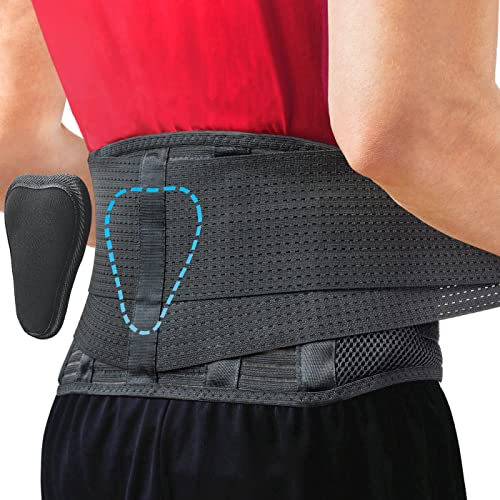
The Sparthos Back Brace is the breathable everyday belt in this line-up, for people who want meaningful support without feeling strapped into equipment. Vertical support stays keep the belt from rolling at the top edge when you sit, stand, and bend through the day. Against the spine sits an adjustable lumbar pad adding focused compression; reposition it to match your own curve, which matters because lumbar curves sit at different heights on different bodies.
This listing is the Small size, fitting waists of about 31 to 38 inches following the brand size chart, with the same design offered across a wider ladder of sizes. The brace is light, at under a pound, and made for extended wear, including under clothing at work. Adjust tension through the day, loosening for desk time and tightening before you lift, carry, or train. It suits office hours, retail and care work, gym sessions, and weekend projects. Support sits mid-group: firmer than a plain elastic belt, less rigid than the Mueller. This model is known for a generous cut, so check the chart carefully if your measurement lands at the top of a size range.
Specs
- Size listed: Small, fits waists 31 to 38 inches (follow the brand size chart at the navel)
- Support structure: Vertical support stays to resist rolling, plus an adjustable lumbar pad
- Model number: SPH-BB-06; manufacturer Clevum OU
- Weight and size: 13.8 ounces; package about 11.02 x 7.68 x 1.73 inches
- Closure: Adjustable strap system with hook-and-loop fastening
- Intended uses: Lower back pain, sciatica, herniated disc, and scoliosis support at home and at work
Copper Fit Rapid Relief Back Brace

The Copper Fit Rapid Relief Back Brace adds something none of the other belts here offer: therapy alongside support. It includes a gel pack that can be used hot or cold, pairing compression with warmth for a stiff morning back or with cold after a strain or a heavy shift. Combining the two steps into one wearable brace is a real convenience, because the pack stays placed against the lower back while you move around the house.
The brace itself uses dual adjustable straps with a secure double-belt closure: a main wrap plus a second layer of compression you can tighten to taste. Flexible stabilizers provide structure, and the copper-infused fabric helps control odor during repeated wear. The adjustable fit suits households where more than one person may use the same brace. Follow the gel pack heating and cooling instructions carefully, and keep therapy sessions to sensible lengths rather than wearing heat for an entire shift. For firmness it sits mid-group, with the therapy pack as the deciding extra. If your routine is as much about soothing muscles after work as supporting them during work, this is the most complete package here.
Specs
- Therapy: Removable gel pack for hot or cold use, worn inside the brace
- Support structure: Flexible stabilizing supports in the back panel
- Closure: Dual adjustable straps with double-belt closure for customized compression
- Fabric: Copper-infused material to help reduce odor build-up
- Fit: Adjustable unisex fit for men and women, for home and work use
- Intended uses: Lower back pain, herniated disc, sciatica, scoliosis, and lumbar support
Comparison Summary
These five belts divide cleanly by need. For the firmest feel, the Mueller leads with its eight steel springs and wide panel. For focused lumbar pressure plus the widest size ladder, choose the FEATOL. For discretion and airflow, the BraceUP B601 is the slim mesh option that stays comfortable under clothing through warm shifts.
The Sparthos is the balanced everyday belt, suiting mixed days of sitting, standing, and light lifting. The Copper Fit Rapid Relief stands apart as the therapy option. Across all five, the same rules decide satisfaction: measure where the brand tells you to measure, and set compression firmly but not so tightly that breathing is restricted.
Frequently Asked Questions
How tight should a back support belt feel?
It should feel snug and supportive, like a firm hug around your midsection, while still letting you breathe deeply and bend comfortably. Set the main wrap first, then use the secondary straps to add compression. If you feel numbness, sharp pressure on your ribs or hips, or you cannot take a full breath, loosen it.
How many hours a day can I wear a back belt?
Wear it for the demanding parts of the day, such as lifting, long standing shifts, driving, or heavy chores, rather than continuously from morning to night. Constant use can encourage your core muscles to do less work over time. Put it on for work blocks, remove it during breaks, and pair it with movement, stretching, and core strengthening.
Should I measure my waist or my navel for sizing?
Follow the measurement point for the model you are buying, because brands differ. FEATOL and Sparthos size by circumference around the navel, while BraceUP and Mueller size by waist measurement. Measure over light clothing, standing relaxed, and compare the number with the published range. If you land between sizes, prefer the fit the brand recommends for that boundary.
Can a back support belt help my posture at a desk?
Yes, within limits. A belt gives gentle compression and a physical reminder to sit upright instead of slumping, and the Sparthos and BraceUP designs here are slim enough for a desk. A belt cannot fix a poor workstation, though: set your screen at eye level, keep your feet flat, and stand up and move regularly.
Conclusion
The best back support belts match support structure to the work in front of you. Choose the Mueller for spring-backed firmness, the FEATOL for a padded brace with an exceptional size range, the BraceUP for breathable discretion, the Sparthos for balanced everyday wear, and the Copper Fit Rapid Relief when hot and cold therapy belongs in your routine. Measure carefully and keep your own muscles active, and a good belt becomes steady support for workdays, lifting, and daily chores.
More from Amazon
Programs that pair well with the guide above. Offers and eligibility are set by Amazon and may change.
Collect the home and kitchen items you want in one registry that guests can shop from.
Create a wedding registrySet up recurring deliveries of everyday items on eligible products. Terms and savings are set by Amazon.
Explore Subscribe & SaveFree shipping on eligible items, Prime Video and more. Eligible new members can start with a free trial.
Start a Prime free trialAudiobooks and podcasts to listen to on the go. Eligible new members can start with a free trial.
Try Audible freeAs an Amazon Associate we earn from qualifying purchases.

Write Your Review
No reviews yet. Be the first to share your experience!