

Key takeaways
- Compare the best projector screens on gain, screen material, size and mounting style to get a brighter, sharper picture from any projector at home.
As an Amazon Associate we earn from qualifying purchases.
Disclosure: This article contains affiliate links. If you buy through these links, we may earn a commission at no extra cost to you.
Projecting onto a bare wall leaves a lot of picture quality on the table. Wall paint adds texture, tint, and uneven reflection, so fine detail softens, blacks wash out, and brightness varies from one side of the image to the other. A dedicated screen fixes all three problems at once: the surface is smooth, color neutral, and engineered to reflect light evenly toward your seats. That is why the best projector screens can make the same projector look noticeably brighter and sharper without changing any setting on the projector itself.
The five screens below cover the main ways people watch at home: manual pull-down models for rooms that double as presentation spaces, fixed-frame models for dedicated viewing rooms where flatness matters most, and a foldable fabric screen that travels anywhere. Every pick is a 16:9 model between 100 and 120 inches. Read the buying criteria first, because gain, material, and mounting style decide whether a screen suits your room far more than diagonal size alone.
How to Choose the Right Projector Screen
Gain describes how much light the surface reflects back toward the viewer compared with a plain white reference surface. A gain figure near 1.0 spreads light widely and evenly, which suits wide seating. A figure above 1.0 concentrates more brightness toward the center seats, which helps in rooms with some ambient light, while a figure well below 1.0 is reserved for special ambient-light-rejecting surfaces paired with specific projector types. For a general home setup, a gain between 1.0 and 1.3 is the versatile zone.
Material shapes both sharpness and viewing angle. Matte white vinyl and woven surfaces diffuse light smoothly, hold fine detail from 4K sources, and keep colors accurate from seat to seat. Polyester fabric screens trade a little surface perfection for foldable portability. Black backing matters on any material, because it stops light passing through the surface and keeps the image punchy instead of milky.
Size should follow seating distance and room width rather than ambition. A 100-inch diagonal suits viewers sitting roughly eight to twelve feet away, while a 120-inch diagonal fills rooms where the main seats sit ten to fifteen feet back. Check the full frame or case width, not just the diagonal, so the screen fits your wall with space to spare.
Mounting style is the final decision. Fixed-frame screens hold the material under constant tension, so the surface stays glass-flat and free of waves, but they claim permanent wall space. Manual pull-down screens roll away into a slim case, which suits multi-use rooms, yet the free-hanging material can show slight edge curl over time. Foldable fabric screens hang from hooks or a frame you supply and pack away to almost nothing, at the price of a less formal finish.
Elite Screens Manual B 100-Inch Pull-Down Screen (M100H)

Specs
- Diagonal: 100 inches, 16:9 aspect ratio
- Material: MaxWhite 2 front projection surface, black backed
- Gain: 1.1 with 180-degree viewing angle
- View size: 49.2 inches high by 87.4 inches wide
- Mounting: dual wall or ceiling installation in a steel case
- Operation: manual pull-down with auto-lock and slow retract mechanism
- Weight: 15 pounds
The Elite Screens Manual B is the safe, proven pull-down for a room that works as both office and cinema. Its MaxWhite 2 surface is the highlight: the fine texture resolves 4K detail cleanly, the black backing blocks light bleed, and the even diffusion means the picture holds together even for viewers seated well off to the side during a presentation or a family movie night.
The hardware is equally practical. The steel case mounts to a wall or ceiling with the included kit, the auto-lock holds the screen at varied heights in small increments, and the slow retract mechanism rolls the material back gently instead of snapping it home. A lanyard is included so the pull handle stays reachable when the case sits high. Elite Screens notes this surface suits standard-throw projectors rather than short-throw or ultra-short-throw models, so pair it with a conventional projector placed across the room. For most living rooms and hybrid workspaces, this is the balanced default.
Silver Ticket Products STR Series 120-Inch Fixed Frame Screen (STR-169120)

Specs
- Diagonal: 120 inches, 16:9 aspect ratio
- Material: white vinyl projection surface, black backed
- Gain: 1.1 with wide viewing for 4K and 8K sources
- Overall frame size: 109.25 inches wide by 63.63 inches high
- Frame: six-piece extruded aluminum wrapped in black velvet
- Tension: rod system that stretches the material fully taut
- Weight: 33 pounds, wall mounted
If your screen can stay on the wall full time, a fixed frame delivers the flattest picture of any style here, and the Silver Ticket STR Series is the benchmark in its class. The six-piece aluminum frame assembles around the vinyl surface, and the tension rod system pulls the material drum-tight on every edge. With no waves, ripples, or curl to bend the image, text stays crisp during presentations and fine film detail stays put during movies.
The frame itself helps the picture too. It is wrapped, not flocked, in light-absorbing black velvet, so any slight overshoot from the projector disappears into the border instead of glowing on the wall. The white vinyl surface is rated for 4K and 8K content and supports active 3D as well. Assembly takes patience and a helper, and the finished screen is a permanent fixture, but for a dedicated viewing room or a fixed presentation wall, nothing else in this group matches its surface discipline.
Akia Screens Fixed Frame 120-Inch Screen (AK-FF120WH2)
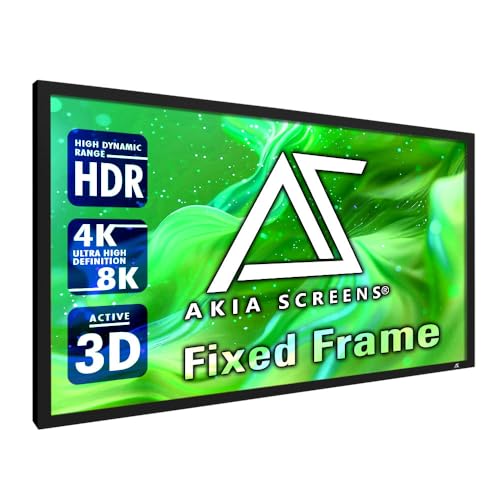
Specs
- Diagonal: 120 inches, 16:9 aspect ratio
- Material: CineWhite UHD-B surface, ISF certified
- Gain: 1.3 with 180-degree viewing angle
- Compatibility: 8K, 4K Ultra HD, and active 3D ready
- Frame: lightweight aluminum with black velvet finish
- Mounting: wall mount fixed frame for indoor use
- Surface care: smooth matte finish that wipes clean
The Akia fixed frame offers a slightly brighter take on the dedicated-room formula. Its CineWhite UHD-B material carries a 1.3 gain figure, the highest among the conventional surfaces in this roundup, so it returns a touch more brightness to the center seats. That helps larger 120-inch images, which spread projector light over a wide area, and it helps rooms where you cannot darken every window completely.
Color accuracy is the other strength. The surface is ISF certified, which speaks to neutral color reproduction, and the full 180-degree viewing angle means brightness and color stay consistent across a wide sofa or a row of office chairs. Like the Silver Ticket, it uses a tensioned fixed frame with a velvet-wrapped border for a clean, cinema-style edge. Choose the Akia when your projector sits in a brighter room or when you simply want the extra punch its higher gain figure provides, and choose the Silver Ticket when an exactly neutral 1.1 surface better matches a fully darkened room.
Mdbebbron 120-Inch Foldable Projector Screen (PSJY-001)

Specs
- Diagonal: 120 inches, 16:9 aspect ratio
- Material: natural polyester fabric, anti-crease design
- View size: 104 inches wide by 58 inches high
- Viewing angle: 160 degrees, front and rear projection supported
- Weight: 1.7 pounds, folds flat for travel and storage
- Mounting: hangs from included hooks, ropes, and adhesive pads
- Care: hand washable and machine washable surface
The Mdbebbron is the opposite of a permanent installation, and that is exactly its appeal. The entire 120-inch surface is a sheet of polyester fabric that folds down into a small bag, weighs under two pounds, and hangs almost anywhere: on wall hooks in a rental apartment, on a garage door for a backyard movie, or on a frame at a campsite. The widened black border helps the hung sheet pull into a clean rectangle, and the anti-crease fabric smooths out well once tensioned.
It also supports projection from either side, so the projector can sit behind the screen with no shadows when people move around. You give up the perfect flatness of a tensioned frame, and careful hanging matters, since uneven tension shows as gentle waves. For travel, temporary rooms, outdoor nights, and anyone who cannot drill into walls, those trade-offs are easy to accept.
PERLESMITH 100-Inch Manual Pull-Down Screen (PSMS1)

Specs
- Diagonal: 100 inches, 16:9 aspect ratio
- Gain: 1.2 with 150-degree viewing angle
- Material: matte surface with heavy-duty black PVC backing
- Compatibility: 4K, 3D, and 1080P HD ready
- Operation: manual pull-down with auto-locking mechanism
- Mounting: wall or ceiling mount for indoor or outdoor use
- Weight: 7.85 kilograms in a metal housing
The PERLESMITH PSMS1 is a compact pull-down that leans a little brighter than the Elite Screens model. Its 1.2 gain figure nudges image brightness upward, which pairs well with mid-brightness portable and office projectors, while the 150-degree viewing angle still covers a normal sofa arrangement comfortably. The black PVC backing keeps light from leaking through the surface, preserving contrast when there is light behind or around the screen.
The auto-locking mechanism holds the screen at the height you choose, and the housing mounts on a wall or ceiling in the usual way. At 100 inches it suits smaller rooms than the 120-inch fixed frames, and it rolls out of sight when the room returns to work duty. Pick the PERLESMITH when you want a pull-down with a bit more brightness on tap; pick the Elite Screens Manual B when the widest possible viewing angle for side seats matters more.
Comparison Summary
All five screens share a 16:9 shape, but they split cleanly by lifestyle. For a permanent wall, the Silver Ticket STR-169120 and the Akia AK-FF120WH2 hold their surfaces under constant tension for the flattest picture; the Akia adds a higher 1.3 gain figure for brighter rooms, while the Silver Ticket keeps a neutral 1.1 surface for darkened rooms. For rooms that must change roles, the Elite Screens Manual B and the PERLESMITH PSMS1 roll away into slim cases, with the Elite offering the widest viewing angle and the PERLESMITH offering slightly higher gain in a 100-inch size. For travel, rentals, and outdoor use, the Mdbebbron folds into a bag, hangs from hooks, and accepts projection from front or rear. Match the mounting style to your room first, then let gain and size settle the final choice.
Frequently Asked Questions
What size projector screen should I choose for my room?
Base the choice on seating distance. A 100-inch diagonal works well when the main seats sit about eight to twelve feet from the wall, and a 120-inch diagonal suits seating ten to fifteen feet back. Also measure the full case or frame width, since a 120-inch frame spans roughly nine feet, and leave a little clearance on each side.
Does a higher gain figure always mean a better picture?
No. Higher gain concentrates reflected light toward the center seats, which looks brighter from those seats but can narrow the useful viewing angle and, on some surfaces, create a bright spot in the middle of the image. A gain near 1.0 to 1.1 gives the most even picture for wide seating, while figures around 1.2 to 1.3 help in brighter rooms with seating near the center.
Can I use these screens with a short-throw projector?
The fixed-frame and foldable models tolerate placement flexibility reasonably well, but manual pull-down surfaces are the most sensitive, because any slight wave in a free-hanging surface distorts the geometry of a short-throw image. Elite Screens specifically advises against using the Manual B with short-throw or ultra-short-throw projectors. For those projector types, a tensioned fixed frame or a screen designed for that throw distance is the safer match.
How do I keep a projector screen clean and flat?
Dust the surface gently with a dry, soft cloth and avoid touching the viewing area with bare hands, since skin oils mark matte surfaces. The Mdbebbron fabric can be washed, while vinyl and coated surfaces should only be wiped with a slightly damp cloth and mild soap, then left to dry fully before retracting. Fixed frames stay flat on their own; pull-down screens stay flattest when left extended briefly after use and retracted slowly.
Conclusion
A good screen is the quiet upgrade that makes every projector look better. Choose a fixed frame from Silver Ticket Products or Akia Screens if the wall is yours to claim and flatness is the priority. Choose a pull-down from Elite Screens or PERLESMITH if the room must return to everyday use between viewings. Choose the Mdbebbron if the screen needs to travel, hang temporarily, or live outdoors for movie nights. Any of the five will deliver a brighter, sharper, more even picture than a bare wall, and the right one is simply the one whose mounting style and gain figure fit the way you actually watch.
More from Amazon
Programs that pair well with the guide above. Offers and eligibility are set by Amazon and may change.
Collect the home and kitchen items you want in one registry that guests can shop from.
Create a wedding registrySet up recurring deliveries of everyday items on eligible products. Terms and savings are set by Amazon.
Explore Subscribe & SaveFree shipping on eligible items, Prime Video and more. Eligible new members can start with a free trial.
Start a Prime free trialAudiobooks and podcasts to listen to on the go. Eligible new members can start with a free trial.
Try Audible freeAs an Amazon Associate we earn from qualifying purchases.
Write Your Review
No reviews yet. Be the first to share your experience!