

Key takeaways
- Nose bridge: It should not force the mask downward or block comfortable breathing.
- Eye pockets: They should surround the eyes rather than press directly on closed eyelids.
- Temples: Compression should feel broad and even, not like a pinching band.
- Strap and padding: Soft, wipeable materials are preferable to rough fabric or exposed seams.
Best Eye Massagers for Soothing Screen Fatigue
The best eye massager for regular screen fatigue is a quiet, adjustable heated model with moderate compression, a comfortable bridge, and at least 60 minutes of usable battery life—not necessarily the model with the strongest squeezing action.
Eye massagers are wellness devices that combine some mix of warming pads, air compression, vibration, and music. They may feel relaxing after extended screen use, but they do not replace an eye examination, prescribed treatment, regular breaks, adequate lighting, or corrective lenses. If you have eye pain, sudden vision changes, persistent headaches, swelling, or a diagnosed eye condition, ask an optometrist or physician before using one.
Our top picks

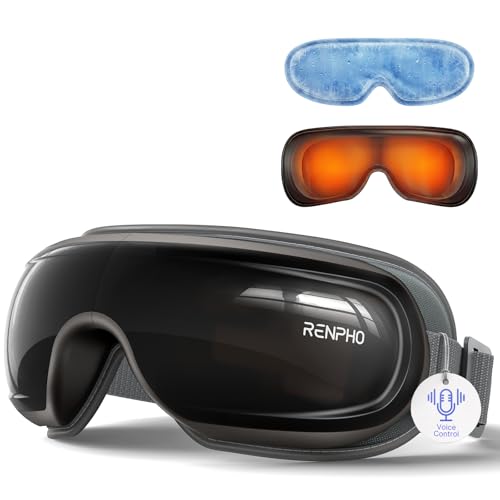


As an Amazon Associate we earn from qualifying purchases at no extra cost to you. Ratings are shown as listed on Amazon.
Quick picks by buying situation
| Situation | Best type to choose | Prioritize | Acceptable compromises |
|---|---|---|---|
| Daily computer or phone use | Adjustable heated compression mask | Low noise, soft eye pockets, selectable pressure, 10–15 minute timer | Vibration is optional |
| Travel or shared office | Compact foldable wireless model | Under 350 g, USB-C charging, quiet operation, washable contact surfaces | Shorter battery life |
| First-time user or pressure-sensitive face | Heat-and-vibration model with little or no compression | Gentle controls, roomy eye cavities, easy stop button | Less pronounced massage sensation |
| Frequent evening use | Quiet model with moderate heat and replaceable or durable padding | Comfort, cleaning, battery capacity, automatic shutoff | Higher purchase price |
| Lowest-cost trial | Simple heated eye mask | Temperature control, timer, washable cover | No compression, vibration, or wireless features |
What separates the best eye massagers?
Heat settings
Heat is usually the most consistently useful feature for relaxation. Look for at least two or three temperature levels rather than a single fixed setting. Many consumer models operate in an approximate 38–42°C range, although advertised temperatures and the warmth felt at the skin are not identical.
A lower setting is more suitable for longer sessions or sensitive skin. A higher setting may feel pleasant briefly but can become uncomfortable around the eyelids. The heating surface should warm gradually and shut off automatically after roughly 10–20 minutes. Avoid models that become hot enough to make you want to remove them immediately; more heat does not mean a better massage.
Compression intensity and pressure distribution
Air compression creates the pulsing sensation around the forehead, temples, and eye sockets. Adjustable intensity matters more than the maximum setting. Strong compression can feel restrictive, particularly if the mask presses directly on the eyelids, the bridge of the nose, or the temples.
The most comfortable designs use separate inflatable zones or broad padded contact areas. A narrow strap and a single hard pressure point are warning signs. If you wear glasses, remove them before use; most eye massagers are not designed to operate over spectacles.
Vibration: pleasant extra or unnecessary feature?
Vibration can add a gentle buzzing sensation around the temples, but it is not essential. It becomes distracting when the motor transmits vibration into the nose or makes the entire mask rattle. If you plan to use the device while listening to an audiobook or relaxing before sleep, choose independently adjustable vibration or a vibration-off mode.
Noise
The small air pump is often the loudest component. For comparison, a quiet bedroom is commonly around 30 dB, normal conversation is approximately 60 dB, and many eye massagers fall somewhere between those levels depending on the mode and how closely the device sits to the ears. Manufacturer noise figures are not always measured under the same conditions.
For shared spaces, aim for a model described as quiet and avoid assuming that a smaller mask is automatically quieter. A soft mechanical hum may be tolerable; repeated clicks, high-pitched pump noise, or loud music playback can make a relaxing session less useful.
Fit and eye-area comfort
Fit is the deciding factor for many users. Measure the approximate width across your brow and compare it with the manufacturer’s face-size guidance. The strap should hold the mask in place without requiring tight tension. The eye cavities should leave enough room for eyelashes and should not press against the eyeballs when the compression cycle inflates.
Check four areas before buying:
- Nose bridge: It should not force the mask downward or block comfortable breathing.
- Eye pockets: They should surround the eyes rather than press directly on closed eyelids.
- Temples: Compression should feel broad and even, not like a pinching band.
- Strap and padding: Soft, wipeable materials are preferable to rough fabric or exposed seams.
People with a larger head, prominent brow, long eyelashes, makeup, facial sensitivity, or claustrophobia may prefer a looser, open-sided heat mask over a fully enclosed compression design.
Head-to-head comparison of the main designs
| Design | Typical weight | Typical session and battery | Best feature | Main drawback |
|---|---|---|---|---|
| Heated fabric eye mask | 150–300 g | 10–30 minute sessions; often 2–8 hours per charge | Lightweight comfort and low noise | No true compression massage |
| Heated vibration mask | 250–400 g | 10–15 minute sessions; roughly 2–6 hours per charge | Simple controls and gentle sensation | Motor noise and limited fit adjustment |
| Air-compression mask | 300–500 g | 10–20 minute sessions; roughly 1.5–5 hours per charge | Most noticeable pulsing massage | Bulkier and more likely to feel tight |
| Heat, compression, and vibration mask | 350–550 g | 10–15 minute sessions; roughly 1.5–4 hours per charge | Most adjustable experience | More weight, noise, and parts that can wear |
These are practical market ranges rather than specifications for one particular product. Battery duration varies substantially with heat, compression, vibration, music, and standby drain.
Battery life: convert the specification into real use
A device advertised for 120 minutes of operation may deliver fewer sessions when all features are enabled. For example, if a fully charged mask provides 120 minutes and each session lasts 15 minutes, the theoretical maximum is:
120 ÷ 15 = 8 sessions
If heat and compression reduce practical runtime by 25%, the useful result is closer to six sessions. Someone using the mask every evening would therefore recharge about once a week. USB-C charging is convenient, but a proprietary charging cable is not necessarily a problem if it can be replaced; losing a nonstandard cable can make a working device difficult to use.
How to use an eye massager comfortably
- Remove glasses, contact lenses, makeup, and facial products that could transfer onto the padding.
- Charge the device and select the lowest heat and compression settings first.
- Position the eye cavities before tightening the strap. The mask should stay in place without pressing firmly.
- Start with 5–10 minutes, then increase only if the sensation remains comfortable.
- Stop immediately if you feel eye pain, numbness, dizziness, nausea, excessive heat, or a worsening headache.
- Wipe the contact surfaces with a lightly damp cloth according to the manufacturer’s cleaning instructions, then allow them to dry fully.
Do not use an eye massager while driving, walking near hazards, or sleeping unless the manufacturer specifically designs it for that purpose. Its automatic shutoff is a safety feature, not an invitation to leave it running unattended.
Durability and ownership realities
The fabric around the eye openings and the adjustable strap usually show wear before the heating elements fail. Sweat, skin oil, makeup, and hair products can stiffen padding and create odor. A removable or wipeable liner is therefore more valuable than decorative features.
- Clean the mask after frequent use, but do not soak the electronic housing.
- Store it flat or in its case so the folding hinge and air channels are not stressed.
- Do not bend the mask sharply around the nose bridge.
- Keep the charging port dry and avoid charging a visibly damaged battery.
- Check the return policy carefully because fit and pressure comfort cannot be judged from specifications alone.
Common mistakes include choosing maximum compression immediately, placing the eye pockets too low, using the device over contact lenses, and buying a bulky model for travel. A simpler mask that fits correctly will usually be used more often than a feature-heavy model that feels noisy or restrictive.
Bottom line
Choose a heated compression model with multiple intensity levels if you want the fullest massage experience. Choose a heated vibration mask if you are sensitive to pressure or noise. Choose a simple heated fabric mask if light weight, portability, and easy cleaning matter most. Across all three categories, comfortable eye pockets, gradual heat, automatic shutoff, and a washable contact surface are better predictors of regular use than the number of advertised modes.




Write Your Review
No reviews yet. Be the first to share your experience!