

Key takeaways
- Check the frame: leverage bars need solid wood trim at least about 3/4 in thick; avoid hollow or loose molding.
- Do not kip or swing on a doorway bar; dynamic force can pop it loose.
- Test with your weight while keeping your feet on the floor before you hang freely.
- Re-check bolts on wall-mounted bars monthly for the first three months.
- Leave at least 2 ft of overhead clearance for full-range pull-ups.
The best pull-up bar for most homes is a doorway bar that braces against the frame without screws, such as the Perfect Fitness Multi-Gym or the Iron Gym; if you want to train hard for years, a wall-mounted or ceiling-mounted bar or a freestanding power tower is safer and more stable. The right choice depends on your door frame, your body weight and how many grips you want. Check the maximum load, the door trim width and the grip options before you buy.
Our top picks



As an Amazon Associate we earn from qualifying purchases at no extra cost to you.
Quick comparison of the best pull-up bar types
| Pick | Best for | Key specs | Install | Price range |
|---|---|---|---|---|
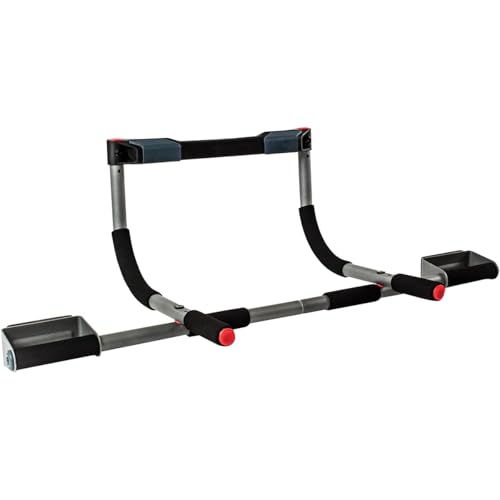
| Perfect Fitness Multi-Gym Doorway Bar | Best overall doorway bar | Multiple grips; rated up to about 300 lb per the brand | No screws; leverage fit on door frame | Budget to mid-range |
| Iron Gym Total Upper Body Workout Bar | Best classic doorway bar | Three grip positions; about 300 lb rating | Hooks over door frame, no drilling | Budget |
| Wall-mounted bar (Yes4All and similar) | Best for long-term strength training | Steel bar; commonly 300 to 500 lb ratings | Lag-bolted into studs | Mid-range |
| Ceiling-mounted bar | Best for tall users, kipping, rings | Heavy-gauge steel; needs joists | Bolted to joists | Mid-range |
| Power tower (dip station + pull-up) | Best all-in-one | Dips, knee raises, pull-ups; 250 to 400 lb ratings | Freestanding; needs floor space | Mid-range to upper-mid |
| Freestanding squat-rack pull-up bar | Best for serious lifters | 11 or 12 gauge steel; 500+ lb rack-level rating | Bolt-together | Upper-mid to premium |
Best overall doorway bar: Perfect Fitness Multi-Gym
The Multi-Gym uses a leverage design that presses against the top of the door frame and the wall, so no screws are required. It has several grip positions, including neutral and wide, which lets you vary your pull-ups to spread the load across your shoulders and elbows. The trade-off is that leverage bars rely on a sturdy trim, and thin or old molding can flex under dynamic movement. It is best for strict pull-ups, chin-ups and hanging core work, not kipping.
Best classic doorway bar: Iron Gym
The Iron Gym hooks over the top of the frame and uses the door’s own structure for support. It is light, folds away and works well in apartments where drilling is not allowed. The padded grips make hangs more comfortable. The downside is that the hooks can mark paint or dent soft wood trim, and the bar sits at the top of the frame, so tall users may have to bend their knees at the bottom.
Best for long-term training: wall-mounted bar
A wall-mounted pull-up bar bolted into studs gives you a fixed, rock-solid hang. Steel bars with 300 to 500 lb load ratings suit heavier users and weighted pull-ups. The compromises are permanent holes in the wall and the need to find studs at the correct spacing, normally 16 inches on center. For anyone doing pull-ups more than twice a week, this is the setup that holds up best over the years.
Best for tall users: ceiling-mounted bar
If you have an exposed joist or a garage ceiling, a ceiling-mounted bar gives full-range pull-ups without hitting your head and leaves room for muscle-ups and rings. It requires lag bolts into joists, and ceiling heights of at least 8 ft are preferable. Do not attach to drywall alone.
Best all-in-one: power tower
A power tower combines a pull-up bar with dip handles and a vertical knee raise station. It needs floor space of roughly 3 by 4 ft and can wobble if the base is narrow, so look for a wide stance and rubber feet. It suits people who want upper body variety without installation. Budget models can have lower-weight ratings, so confirm the listed capacity covers your weight with a safety margin.
Best for serious lifters: freestanding rack with bar
If you already lift, a squat rack with a pull-up bar uses the same footprint and offers the highest load capacity. Heavier gauge steel, wide hole spacing and bolt-down options make it the most stable choice for weighted work. It costs more and takes space, so it is overkill for bodyweight beginners.
How to choose: numbers to check
| Your situation | Choose | Why |
|---|---|---|
| Renting, no drilling | Doorway leverage or hook bar | No screws, removable |
| Body weight above 220 lb | Wall, ceiling or rack-mounted | Higher rated loads and fixed mounting |
| Door frame under 24 in or over 32 in wide | Check the bar’s stated range | Bars fit a narrow range of widths |
| Ceiling height under 8 ft | Doorway or wall-mounted bar | Avoids head clearance problems |
| Want dips and leg raises | Power tower | Multiple stations in one footprint |
As a safety rule, choose a bar with a rated capacity at least 1.5 times your body weight plus any added weight. A 200 lb user holding a 25 lb plate, for example, should target a rating of at least 340 lb.
Install and safety mistakes
- Check the frame: leverage bars need solid wood trim at least about 3/4 in thick; avoid hollow or loose molding.
- Do not kip or swing on a doorway bar; dynamic force can pop it loose.
- Test with your weight while keeping your feet on the floor before you hang freely.
- Re-check bolts on wall-mounted bars monthly for the first three months.
- Leave at least 2 ft of overhead clearance for full-range pull-ups.
Pull-ups can place load on shoulders, elbows and wrists. If you have an injury or a medical condition, speak with a doctor or qualified trainer before starting.
Grip types and what each one trains
| Grip | Main muscles | Joint comfort | Best for |
|---|---|---|---|
| Overhand, wide | Lats, upper back | Hardest on shoulders | Classic pull-ups |
| Underhand, shoulder width | Lats, biceps | Easier for most beginners | Chin-ups, first-rep goals |
| Neutral (palms facing) | Lats, biceps, forearms | Friendliest on wrists | Higher volume training |
| Mixed | Back and grip | Can load one shoulder more | Variety, grip strength |
A simple beginner progression
If you cannot do a pull-up yet, a bar is still useful. Start with dead hangs for 10 to 20 seconds, building to 45 to 60 seconds over a few weeks, because grip strength is often the first limit. Then add scapular pulls, negatives (jump up and lower slowly over three to five seconds) and band-assisted reps. Train on alternating days, for example three days a week, and stop a set one rep before form breaks. This approach spreads the load across tendons that adapt more slowly than muscles. A bar with several grips lets you rotate positions to reduce overuse.
Finally, consider accessories. Chalk helps with sweaty hands, padded straps reduce calluses, and a floor mat protects against a bad dismount. None of these is mandatory, but small additions improve comfort so you keep training consistently.
Frequently Asked Questions
Do doorway pull-up bars damage door frames?
They can mark paint or dent soft trim, especially over time. Padding the contact points with a thin foam or cloth strip reduces damage, and wall-mounted bars avoid the issue altogether.
How much weight can a pull-up bar hold?
Typical doorway bars are rated around 250 to 300 lb, while wall, ceiling and rack-mounted bars commonly reach 400 to 500 lb or more. Always follow the manufacturer’s stated limit and leave a margin.
Are pull-up bars good for beginners?
Yes, and many beginners start with dead hangs and band-assisted pull-ups to build grip and shoulder strength. A bar with multiple grips lets you pick the one that feels best on your wrists.
Where is the best place to install a pull-up bar?
A wall stud, ceiling joist or sturdy door frame with at least 2 ft of clearance above the bar. Garages and basements often work best because of their exposed framing.
Wall-mounted or doorway: which is better?
Wall-mounted is better for stability and heavy use, while doorway bars are better for renters and temporary setups. If you plan to train for more than a few months, mounting is worth the effort.






Write Your Review
No reviews yet. Be the first to share your experience!