

Key takeaways
- Foot-only: compact and usually easiest to use, but it cannot massage the calf.
- Foot and calf: the best compromise for many users; check the upper sleeve height.
- Calf and thigh: offers more coverage but costs more and takes longer to put on.
- Open-ended wraps: easiest to adjust across different leg sizes.
- Enclosed boots: often feel more uniform but require closer attention to measurements.
Best Leg Massagers for Swelling and Sore Muscles
The best leg massager depends on whether you want gentle daily compression, deeper kneading for tired feet, portable recovery sessions, or adjustable coverage from the foot to the upper calf: for most shoppers, a multi-chamber compression wrap is the most versatile choice, while a foot-and-calf kneading unit is better for localized muscle soreness.
Quick picks by situation
| Situation | Best massager type | What to prioritize | Typical price range |
|---|---|---|---|
| Budget-conscious daily use | Calf-and-foot air compression sleeves | Three or more intensity levels, washable liners, simple controller | $40–$100 |
| Sore arches, heels, or soles | Foot kneading massager with optional heat | Open foot wells, removable covers, adjustable foot size | $60–$150 |
| Legs that feel tired after standing | Full-calf compression boots | Sequential chambers, broad size range, pressure adjustment | $100–$350 |
| Frequent travel or limited storage | Compact wrap-style compressor | Foldable sleeves, under 6 lb total weight, dual voltage if traveling abroad | $50–$180 |
| Frequent athletic recovery sessions | Premium pneumatic recovery boots | Rechargeable battery, multiple programs, long warranty | $500–$1,500+ |
Compression versus kneading: the main decision
Compression massagers
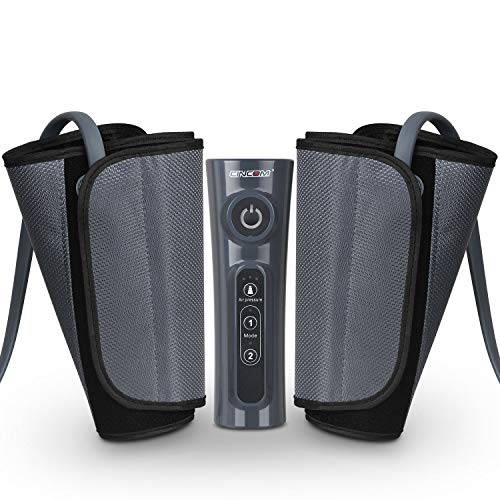
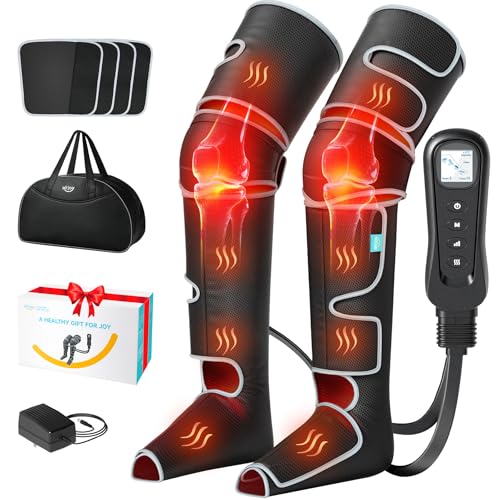
Compression devices use inflatable chambers that tighten around the foot, ankle, calf, or thigh. Sequential models inflate from the lower section upward, while simpler models inflate all sections at approximately the same time. The sensation is more like a rhythmic squeeze than a conventional massage.
Our top picks


As an Amazon Associate we earn from qualifying purchases at no extra cost to you. Ratings are shown as listed on Amazon.
Compression is usually the better match for general leg fatigue and a feeling of heaviness. It also provides more consistent coverage than a small vibrating or kneading device. Look for at least three independently controlled chambers and a timer ranging from 15 to 30 minutes. Six or more pressure settings are useful because comfort varies substantially between users.
Do not assume that the highest pressure is the best pressure. Start at the lowest comfortable setting, especially during your first few sessions. A product that feels effective at a moderate setting is generally more practical than one that is uncomfortable or difficult to put on.
Kneading and rolling massagers
Kneading units use rotating nodes, rollers, vibration, or a combination of these mechanisms. They are particularly useful when the feet are the main problem. Some models extend around the lower calf, but many provide only partial calf coverage.
Kneading can feel more targeted than air compression, but it can also be intense around the arch, heel, or Achilles area. Check whether the rollers can be switched off independently and whether the foot chamber has enough room for your shoe size. A hard, enclosed foot well is less adaptable than a fabric wrap with adjustable straps.
Heat is useful, but it should not decide the purchase
Heat can make a foot or calf session feel more relaxing, particularly when the product offers a separate heat control. It does not automatically make the massager more effective, and many compression boots omit heat because their sleeves and pumps are designed for portability.
Choose adjustable or switchable heat rather than a single fixed-temperature setting. Avoid placing heated devices over numb skin or using them while asleep. People with reduced heat sensation, circulation concerns, diabetes, or an unresolved swelling problem should ask a qualified healthcare professional before using heat or compression.
Coverage and sizing matter more than extra modes
Measure both legs while standing, using the manufacturer’s instructions. Important measurements include foot length, ankle circumference, calf circumference, and sometimes the distance from the heel to the top of the calf sleeve. Use the larger leg measurement if the two sides differ.
As a practical example, suppose a sleeve is designed for calves measuring 12 to 18 inches and your calf measures 17.5 inches. It may fit, but there is little adjustment room for clothing or swelling during the day. A model rated for 12 to 20 inches would provide a more forgiving fit. That extra range can matter more than an additional massage program.
- Foot-only: compact and usually easiest to use, but it cannot massage the calf.
- Foot and calf: the best compromise for many users; check the upper sleeve height.
- Calf and thigh: offers more coverage but costs more and takes longer to put on.
- Open-ended wraps: easiest to adjust across different leg sizes.
- Enclosed boots: often feel more uniform but require closer attention to measurements.
How the leading options compare
| Type | Typical coverage | Session length | Power and portability | Cleaning difficulty |
|---|---|---|---|---|
| Foot kneading unit | Feet, sometimes lower calves | 15–30 minutes | Plug-in; usually 4–10 lb | Moderate; wipe interior carefully |
| Air compression sleeves | Feet and calves | 15–30 minutes | Plug-in or rechargeable; usually 2–6 lb | Easy if liners are removable |
| Full-leg compression boots | Feet, calves, knees, and thighs | 20–45 minutes | Often 6–12 lb; less compact | Moderate; multiple seams and hoses |
| Heated wrap | One calf or both calves | 15–30 minutes | Plug-in; usually under 4 lb | Easy if the wrap is removable |
Brands and product families worth comparing
RENPHO offers several consumer-oriented foot and leg massagers, including models built around compression, kneading, heat, or combinations of those features. Nekteck is known for accessible foot-massage designs, although coverage and control layouts vary by model. For higher-cost pneumatic recovery systems, Hyperice Normatec and Therabody RecoveryAir are established product families to compare for chamber design, programs, battery operation, and warranty support.
These names should be treated as starting points rather than automatic recommendations. Within the same brand, one model may cover only the foot while another reaches the thigh. Confirm the exact dimensions, included power adapter, return policy, and replacement-part availability before buying.
Ownership details that listings often omit
Cleaning
Fabric sleeves absorb sweat, skin oils, and body lotion. Wipe them after each use with a lightly damp cloth and allow them to dry fully before folding. Do not immerse an air pump or controller. If the product has removable liners, wash them according to the care label; avoid assuming that every liner is machine washable.
What wears first
Straps, hook-and-loop fasteners, seams, hose connectors, and pump valves usually face more stress than the massage mechanism itself. Pulling a sleeve open by the hose can loosen its connection. Store the device with hoses loosely coiled rather than sharply bent, and do not place heavy objects on the folded chambers.
Noise and setup
Air pumps make a repeating hum and clicking sound, while kneading motors produce a lower mechanical noise. If you plan to use the device while watching television, look for a published noise specification or choose a model with a remote pump and longer hose. Put the massager on a chair with back support rather than using it while walking or standing.
A simple cost-per-use calculation
Consider a $120 compression sleeve used four times per week for two years. That is approximately 416 sessions, making the equipment cost about $0.29 per session before electricity. If the same device is used only once per week, the cost rises to about $1.15 per session. The calculation shows why fit, cleaning convenience, and storage can be more valuable than a longer list of preset modes: a comfortable device is more likely to be used consistently.
Safe-use checklist
- Read the manual and begin with the lowest comfortable pressure or massage intensity.
- Keep sessions within the manufacturer’s recommended time.
- Stop if you develop pain, numbness, skin discoloration, unusual tingling, or worsening discomfort.
- Do not use a massager over an open wound, irritated skin, or an area that has not been medically assessed.
- Seek professional advice before using compression or heat if you have a diagnosed vascular condition, unexplained one-sided swelling, recent surgery, or reduced sensation.
For most households, a washable foot-and-calf compression wrap with adjustable pressure, a 15- to 30-minute timer, and a generous sizing range offers the best balance of coverage, portability, and price. Choose a kneading-and-heat unit when foot soreness is the priority, and move to full-leg pneumatic boots only when you will use the added coverage often enough to justify their size and cost.






Write Your Review
No reviews yet. Be the first to share your experience!