

The best medicine ball depends on the job: a soft-shell wall ball like the Dynamax Standard for throwing at a target, a dead-bounce slam ball such as the REP Fitness Slam Ball for overhead slams, and a firm rubber ball for partner passes and core work. Using the wrong type is the most common buying mistake, since soft-shell balls are not made for slamming and slam balls do not bounce.
This guide compares real, current models from Dynamax, Rogue, REP Fitness and budget brands, shows how to pick a weight with numbers, and covers care and common mistakes.
Our top picks

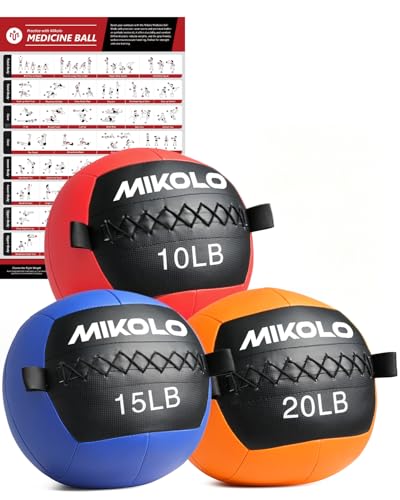


As an Amazon Associate we earn from qualifying purchases at no extra cost to you.
Quick Comparison of the Best Medicine Balls
| Pick | Best for | Key specs | Price range |
|---|---|---|---|
| Dynamax Standard Medicine Ball | Best wall ball, classic soft shell | 14 in diameter, 4 to 30 lb, handmade in the USA | Premium |
| Rogue Medicine Ball | Best consistent-size wall ball | Uniform 14 in diameter at every weight, soft shell | Premium |
| REP Fitness Wall Ball | Best value wall ball | Faux leather, easy grip, 4 to 40 lb range | Mid |
| REP Fitness Slam Ball | Best overall slam ball | Thick rubber shell, sand fill, 5 to 70 lb | Mid |
| Rogue Echo Slam Ball | Best classic slam ball | Textured PVC shell, 9 to 10 in, 10 to 50 lb | Mid |
| Yes4All and ProSource balls | Best budget picks | Entry-level slam and wall balls, widely available weights | Budget |
Specs reflect the makers’ product pages and common listings; weights, diameters and warranty terms vary, so check the exact listing.
Best Wall Ball: Dynamax Standard Medicine Ball
Dynamax is the original soft-shell medicine ball, handmade in the USA for decades. It comes in weights from about 4 to 30 lb at a 14-inch diameter, with a stitched, leather-style cover that is easy to catch and throw. It is a long-time favorite for wall ball workouts and conditioning classes.
The trade-offs are cost and shipping weight. It is among the pricier options, and the soft shell is not designed to be slammed on concrete.
Best Consistent-Size Wall Ball: Rogue Medicine Ball
Rogue makes its soft-shell wall balls at a uniform 14-inch diameter regardless of weight, so your target height and catch form stay the same when you move from 10 lb to 20 lb. That consistency is useful for programs that scale loads. Shipping is a common complaint, and for casual users the premium cost may be more than needed.
Best Value Wall Ball: REP Fitness Wall Ball
REP’s wall ball uses a faux leather cover that is easy to grip and comes in a wide weight range, from light to heavy. It is a sensible middle ground between budget balls and premium brands, and it suits home gym use and group workouts.
Best Overall Slam Ball: REP Fitness Slam Ball
REP’s slam ball has a thick rubber shell filled with sand and spans 5 to 70 lb. Diameter grows with weight: roughly 9 to 10 inches at 5 to 30 lb, 11 to 12 inches at 35 to 50 lb, and 13 to 14 inches at 60 to 70 lb. The maker calls slam balls consumable items, with a one-year home warranty and a shorter commercial warranty, so expect eventual wear.
Best Classic Slam Ball: Rogue Echo
The Rogue Echo has a textured PVC shell for grip and comes in 9 to 10 inch sizes from 10 to 50 lb. It is a good choice if you want a dependable, standard-feeling slam ball. It does not come in light weights below 10 lb, so beginners needing a 5 or 8 lb ball should look elsewhere.
Best Budget: Yes4All and ProSource
These brands make low-cost slam and wall balls that suit most home users. Quality control is less consistent, seams may split sooner, and sizes can vary slightly, but they are a good way to try the training style before spending more.
Which Weight Should You Choose?
| Goal | Starter weight | Progress to |
|---|---|---|
| Wall balls (women, general fitness) | 6 to 10 lb | 14 to 20 lb |
| Wall balls (men, general fitness) | 10 to 14 lb | 20 to 30 lb |
| Slams (power and conditioning) | 10 to 20 lb | 30 to 50 lb |
| Core rotations and passes | 4 to 8 lb | 10 to 15 lb |
| Rehab-style or gentle movement | 2 to 6 lb | As cleared by a professional |
How to Choose a Medicine Ball
Soft shell versus slam ball
Soft-shell balls bounce a little and are meant to be caught or thrown at a wall. Slam balls are filled with sand or similar and barely bounce, so they absorb the impact when slammed on the floor. Never slam a soft-shell ball, as the seams will fail.
Surface and grip
Textured shells help with sweaty hands. Smooth balls are easier to catch cleanly in wall ball drills. Choose based on where you train and how much you sweat.
Diameter
Diameter affects catch form and which muscles work. A consistent 14-inch wall ball standardizes the target. Larger slam balls can be awkward to lift overhead if your hands are small.
Floor protection
Slam balls are tough on thin flooring. Train over rubber mats or a lifting platform to protect the floor and reduce noise.
Care and lifespan
Keep balls out of sun and extreme heat, wipe off dirt, and check seams regularly. Slam balls are a wear item, and leaking sand is a sign to replace.
Sample Workout to Try
A basic circuit shows how the two ball types differ. Choose a weight that lets you finish every rep with good form.
- Wall balls (soft-shell): 3 sets of 12. Squat, throw at a target about 9 to 10 feet high, catch, and go straight into the next squat.
- Overhead slams (slam ball): 3 sets of 10. Reach tall, brace the core, and drive the ball down in front of your feet.
- Rotational throws (soft-shell, against a solid wall): 2 sets of 8 per side.
- Russian twists (light ball): 2 sets of 20 total taps, controlling the turn instead of swinging.
Rest 60 to 90 seconds between sets. Two sessions a week is plenty to start.
Ownership Realities and Common Mistakes
Slam balls wear at the seams and surface, especially on rough concrete, and a ball that leaks sand will bounce unevenly and should be replaced. Soft-shell balls last longer if kept dry and thrown at a smooth wall. Common mistakes include choosing a ball that is too heavy for overhead work, using a soft-shell ball for slams, and skipping floor protection. Buying one mid-weight ball first is smarter than buying a full set.
Frequently Asked Questions
What is the difference between a medicine ball and a slam ball?
A medicine ball is a general term for a weighted ball, often soft shell and bouncy. A slam ball is a dead-bounce type designed to be thrown hard onto the floor.
What weight medicine ball should I buy?
For wall balls, many adults start with 10 to 14 lb. For slams, 15 to 20 lb is common. Pick a weight you can control with good form for 10 to 15 reps.
Can I bounce a slam ball?
Not meaningfully. Slam balls are built to absorb impact, so they barely bounce. If you want rebound, choose a rubber or soft-shell ball.
Can I use a medicine ball against a wall?
Yes, if it is a wall ball or soft-shell type, and the wall is solid. Avoid plaster or drywall where repeated impact may damage it, and use a rebounder or padded wall.
Are medicine ball exercises safe for the back?
Some movements, especially rotations and heavy slams, load the spine. If you have back concerns, start light and ask a qualified professional which exercises suit you.
More from Amazon
Programs that pair well with the guide above. Offers and eligibility are set by Amazon and may change.
Collect the home and kitchen items you want in one registry that guests can shop from.
Create a wedding registrySet up recurring deliveries of everyday items on eligible products. Terms and savings are set by Amazon.
Explore Subscribe & SaveFree shipping on eligible items, Prime Video and more. Eligible new members can start with a free trial.
Start a Prime free trialAudiobooks and podcasts to listen to on the go. Eligible new members can start with a free trial.
Try Audible freeAs an Amazon Associate we earn from qualifying purchases.




Write Your Review
No reviews yet. Be the first to share your experience!